


Friday, Nov. 6, 2026 · about a 5-minute read
Good afternoon. Yesterday we launched a calculator that puts an age on every breakthrough. Today we look up, at the satellites that are about to get fill-ups, tow trucks and repair crews instead of a one-way trip to the junkyard.
The big one
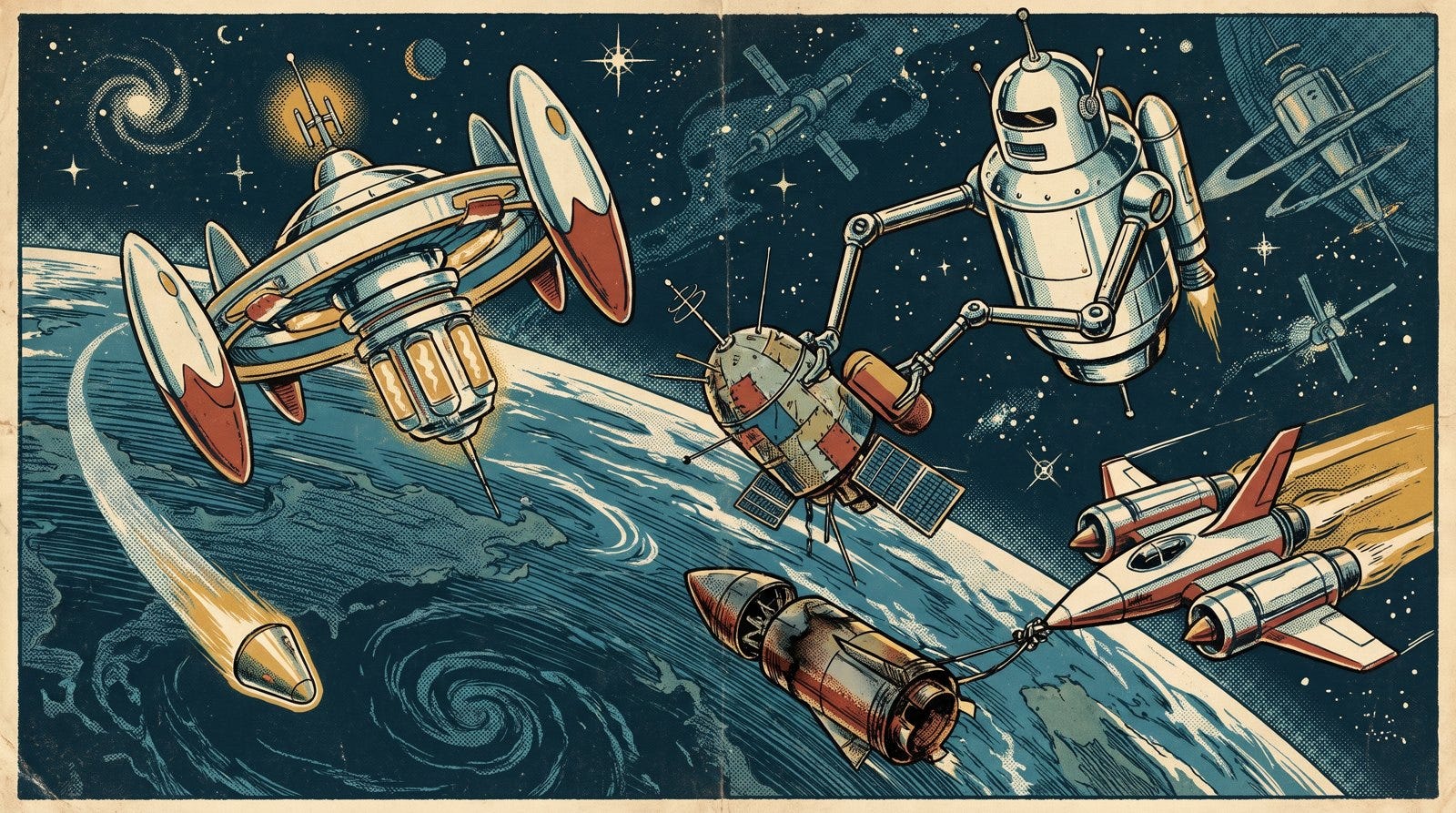
Space Is Getting Gas Stations, Tow Trucks and Robot Repair Crews. A robot mechanic carrying three strap-on fuel pods is climbing toward the high orbit where the big communications satellites live. A small servicing craft built to grab satellites that were never designed to be grabbed reached orbit on Oct. 1, a refueling tanker for the Space Force is built, and a Japanese debris hunter has its rocket booked. NASA's new 368-page field guide to building and fixing things in space counts only hardware that actually exists.
Why it matters: orbit is starting to work like a highway, with places to fill up, crews to fix breakdowns and tow trucks for wrecks, which makes everything up there cheaper and longer-lived. Our odds that a robot straps a fuel pod onto an aging satellite: chance it works 92%, likely by 2027. Read it →
Yesterday on the site
Thinking Machines
What Will You Live to See? Our New Calculator Puts an Age on Every Breakthrough: our new free calculator. A birth year goes in; the next three years of breakthroughs come out, with an age at each step.
Anthropic Says AI Could Start Building Better AI Twice as Fast: what the company's IPO filing says about AI speeding up its own progress, and what it does not claim.
The End of Aging
Boosting One Brain Protein Gave Old Mice Back Their Young Memories: raising one protein in the brain's support cells restored old mice's maze memory.
The End of Disease
A Brain Scan Could Warn of Alzheimer's Years Before the First Symptom: a score built from "super agers" predicted faster decline in 1,300 adults with no symptoms.
Reopening the Liver's Tiny Filters Halved an Alzheimer's Protein in Old Rats: two weeks of an experimental drug cut the main Alzheimer's protein in the blood by half.
An AI-Guided Pill Shrank Pre-Cancer Polyps in 13 of 15 Patients: a daily pill cut inherited colon polyps by a median 47%, with a bigger trial planned for late 2027.
Robots & Self-Driving
Figure's Newest Humanoid Robots Just Walked Out the Factory Door: new Figure 03 robots rolling out of the company's own plant.
Robotaxis Training in Virtual Worlds Aim to Reach Real Streets Faster: Baidu says its simulator makes up to 100,000 km of virtual driving a day.
To the Stars
China Plans to Put People on the Moon Before 2030: uncrewed tests in 2027, 2028 and 2029, then a crewed landing.
Mars Without the 26-Month Wait: Twin NASA Probes Slingshot Past Earth Starting Saturday: two probes that launched with the planets out of line swing past Earth on the way to Mars.
Voyager 1, Launched in 1977, Is Two Weeks From Being a Full Light-Day From Home and Still Talking: the farthest human-made object is about to put a full day between its signal and Earth.
Limitless Energy
Two Tiny Nuclear Reactors Are One Review Away From Switching On: two small reactors won federal safety approval in October and face one last readiness review.
By the numbers
47%: the median shrinkage of inherited colon polyps on Recursion's daily pill, in a 15-patient trial.
100,000 km: the virtual robotaxi driving Baidu says its simulator produces in a day.
16.09 billion miles: how far Voyager 1 will be from Earth on Nov. 18, a 24-hour radio trip each way.
368 pages: the length of NASA's new field guide to building and fixing things in space.
New on the odds board
Yesterday's posts put fresh odds on memory restored in aging brains, a brain scan that flags Alzheimer's risk early, a pill that holds back inherited colon cancer, China's crewed Moon landing, robotaxis trained in simulation, humanoid robots coming off the line, two tiny reactors switching on and AI that speeds up its own progress. Every milestone lives on the calculator.
On the calendar
Nov. 7 and 9: NASA's twin ESCAPADE probes fire their engines as they pass Earth on the way to Mars.
Nov. 7 to 8: NASA's quiet supersonic X-59 appears at the MAX POWER show at Kennedy Space Center.
Nov. 18: Voyager 1 reaches 16.09 billion miles from Earth.
Late 2027: Recursion plans a pivotal trial of its colon-polyp pill.
The story we're following
Alzheimer's is being worked from every side at once. In one day we covered a brain scan that flags risk years before symptoms, a liver drug that halved the main Alzheimer's protein in old rats and a protein that gave old mice back their memories. This morning came a pill plus a vibrating platform that pushed brain proteins out into the blood of 29 healthy adults. Each is early. Together they point to a disease that could be caught sooner and cleared on several fronts.
Quote of the day
"The best way to predict the future is to invent it." — Alan Kay, the computer scientist, who recalled first saying it at a 1971 meeting at Xerox's Palo Alto research center. The robot mechanics climbing to high orbit right now are what that looks like in practice.
Coming up
Today: a wireless implant that cleared excess blood sugar in mice at 3 p.m., an AI chip in orbit that answered its first prompt at 4, a one-dose gene "dimmer switch" for cholesterol at 5, birth control for men without hormones at 6, a shot that could make aging skin snap back at 7, and fusion power from plain water at 8. Saturday's big one: Ray Guns Are Real Now. They Could Swat Drones for a Few Bucks.
Until next time
That's today in the future. If someone you know would want to wake up to this, forward it to them, and if you're reading a forward, subscribe here. It's free every morning.