


Tuesday, Nov. 10, 2026 · about a 5-minute read
Good morning. Yesterday brought a robot butler anyone can build for a reported under $15,000, a one-time CRISPR infusion entering its final test and 3D-printed fusion reactor walls that survived 74 plasma blasts. Today A.I. agents run a DNA lab for eight days on one typed request.
The big one
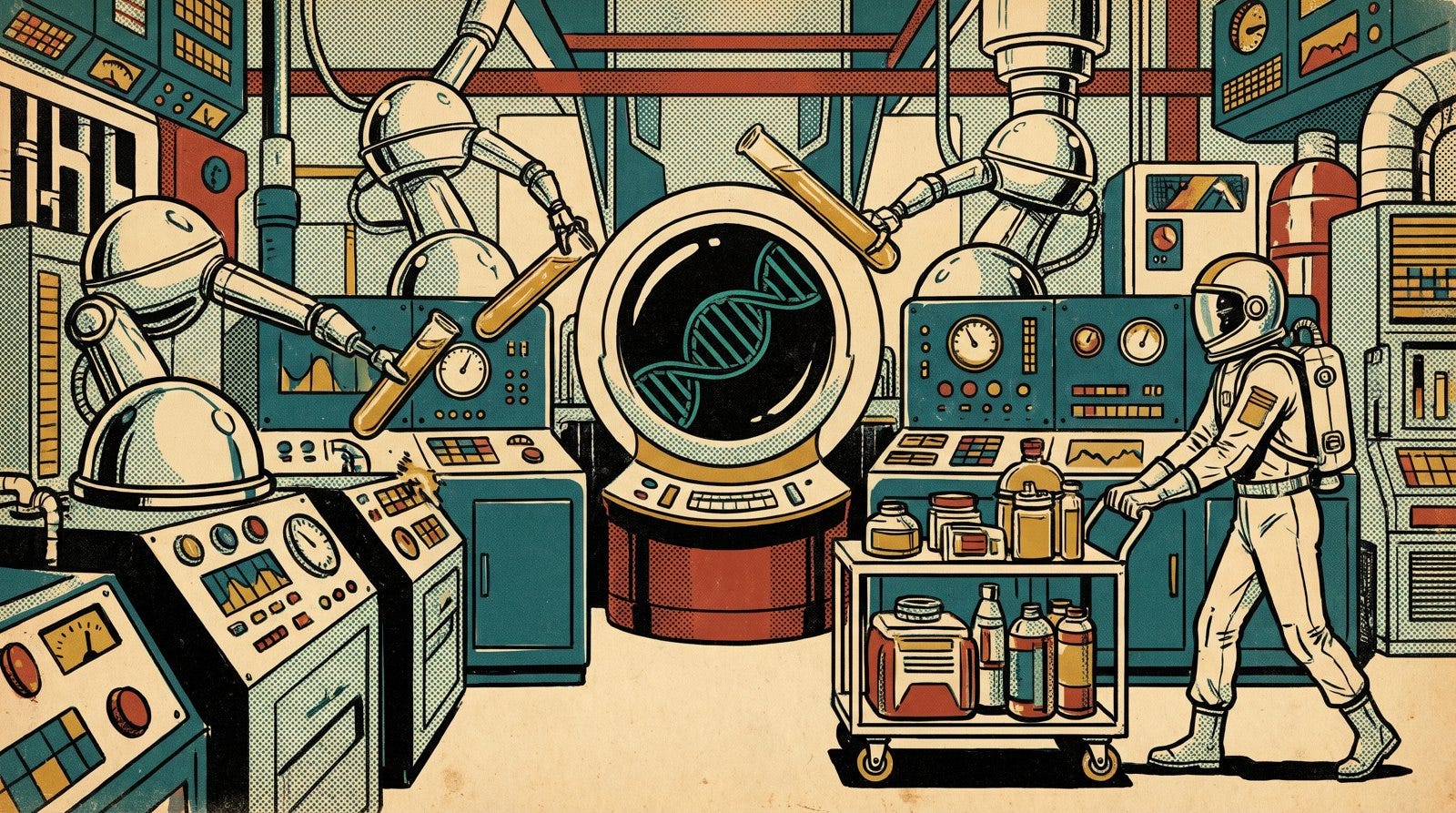
Faster Medical Breakthroughs: AI Ran a DNA Lab for 8 Days From One Typed Request A team of A.I. agents in Shanghai took a single typed instruction and turned it into real DNA experiments, steering robot arms between more than 20 kinds of lab machines while the humans only restocked supplies and fixed hardware. Across four projects it worked faster than the usual approach and kept one job going for about eight and a half days without an error in its result. It repeated results scientists already knew, which is the first test a robot scientist has to pass.
Why it matters: if labs can run around the clock on a sentence of instructions, the slow, hands-on half of science can move at machine speed, and new medicines can get found and tested faster. Our odds that an A.I.-run lab publishes a discovery of new biology: chance it works 85%, likely by 2029. Read it →
Yesterday on the site
The End of Aging
The Exercise Pill Goes Into People Next, Its Maker Says: BioAge says it will file by year-end to start human tests of an exercise-mimicking pill for obesity (company plans).
Old Muscles Haven't Forgotten How to Heal. A Lab Fix Restored the Broken Signal.: in test-tube work, a Kyushu University antioxidant more than doubled how tightly the age-damaged muscle-repair signal HGF grips its receptor; no human trial yet.
Reversing Gray Hair: A Sleep Hormone Brought Color Back for 4 of 20 People: a melatonin scalp solution partly recolored gray hair in 4 of 20 patients in three months, and a 141-person minoxidil trial has finished.
The Test for One-Time Gene Cures: A CRISPR Infusion's Final Trial Is Full: Intellia and Regeneron's one-time CRISPR infusion for an inherited nerve disease finished enrolling its roughly 60-person final trial.
Heart Disease Protection in One Shot: Cholesterol Stayed Down Two Years in Monkeys: Scribe says one shot of its gene "dimmer switch" cut LDL cholesterol more than 50% for at least 24 months in monkeys; the first human trial is running.
Robots & Self-Driving
Robot Butlers That Learn by Watching People: 2.2 Million Hours of Video, Its Maker Says: Beijing start-up LiberAI says its robot brain, trained mostly on human video, scored 36% on 60 tasks it had never seen.
A Robot Butler Anyone Can Build: Free Plans Are Coming for a Sub-$15,000 Bot That Tidies Up: Carnegie Mellon's Pixel, a two-armed home helper reported to cost under $15,000 to build, learned chores from people using handheld tools; open-source plans are promised.
Flying Taxis With No Pilot: The Air Force Bets Nearly $37 Million on Joby's Self-Flying Software: the Air Force raised its commitment to Joby's self-flying software to nearly $37 million (secondary report).
To the Stars
NASA Orders a Solar Power Tower for Its Planned Moon Base: NASA ordered a small solar-and-power tower to test how a Moon base at the lunar south pole gets its electricity.
Cleaning Up Orbit: India Aims for Zero New Space Junk by 2030: India aims for zero new orbital debris from its missions by 2030, and a Hyderabad start-up opened a factory for satellite tow trucks (secondary report).
Limitless Energy
Fusion Plants That Run for Years, Not Seconds: Washington Funds 28 Projects on the Hard Parts: the Energy Department gave $8.5 million to 28 projects with 22 fusion companies on the materials and sensors a working plant needs.
Cheaper Fusion Power Off a 3D Printer: Printed Reactor Walls Survived 74 Plasma Blasts: full-size 3D-printed tungsten tiles came through 74 high-power plasma shots in a U.S. fusion machine intact.
Also new
Ray Guns Against Drone Swarms Are Going Global. China Says Its Lasers Torched Waves of Them.: Chinese state media say lasers downed several waves of low-flying drones in a Gobi Desert test (secondary report, not independently confirmed).
Sci-Fi 3D Displays Go DIY, and the Blueprints Are Free: a hobbyist's open-source Vortex display spins two LED panels to draw a 3D image viewable from any angle, and the plans are free.
Trains in Tubes That Rival Planes Are Back: A Dutch Hyperloop Maker Revives: Hardt Hyperloop is restarting after its March bankruptcy with a U.S.-led round of "several million euros" (secondary report).
By the numbers
74: high-power plasma shots that full-size 3D-printed fusion wall tiles survived intact.
Under $15,000: the reported cost to build Carnegie Mellon's chore-doing robot, Pixel.
4 of 20: patients whose gray hair partly regained color after three months of a melatonin scalp solution.
24 months: how long one shot has held cholesterol down in monkeys so far, its maker says.
New on the odds board
Yesterday's posts put fresh odds on an exercise pill, repairing old muscles, reversing gray hair, a one-time CRISPR cure for an inherited nerve disease, a one-shot cholesterol fix, robots that learn chores by watching people, a build-it-yourself robot butler, pilotless air taxis, power for a Moon base, a cleaner orbit, fusion plant parts, laser drone defense, 3D displays and hyperloop trains. Every milestone lives on the calculator.
On the calendar
This quarter: BioAge expects results from a 160-person trial of its inflammation pill (company plan).
By year-end: BioAge plans to file to start human tests of its exercise-mimicking pill.
First half of 2027: the first cholesterol numbers from people in Scribe's one-shot gene trial.
About 18 months out: the main result of the one-time CRISPR infusion's final trial.
2030: India's target for zero new orbital debris from its missions.
The story we're following
Robots that learn chores by watching people. In one day we covered a Beijing start-up training a robot brain mostly on video of humans and a Carnegie Mellon helper that learned to tidy up by copying people working with handheld tools. Practice data has been the expensive part of building a home robot, and both point to the same shortcut: let people do the chores once, and let the robots learn from them.
Quote of the day
"If I have seen further, it is by standing on the shoulders of giants." — Isaac Newton, in a 1675 letter to Robert Hooke. Today A.I. agents ran a DNA lab by standing on decades of known results, the first step toward finding new ones.
Coming up
Already up this morning: Tesla trading the Cybertruck for more robotaxis, an electric comb that regrew hair in mice and data centers headed for space. Still to come today: robots that learn to fold laundry from human hands at 9 a.m., an Alzheimer's pill trial that answers next week at 10, a flying taxi three of five steps through FAA approval at 11 and A.I.'s lab skills more than doubling at noon.
Until next time
That's today in the future. If someone you know would want to wake up to this, forward it to them, and if you're reading a forward, subscribe here. It's free every morning.