


Monday, Nov. 9, 2026 · about a 5-minute read
Good morning. Yesterday brought a nuclear-powered rover headed to the Moon to dig for ice, Uber's $10 billion plan for 2,000 robotaxis and an A.I. that turns plain-English requests into working proteins. Today lab-grown human livers get ready to screen A.I.-designed drugs.
The big one
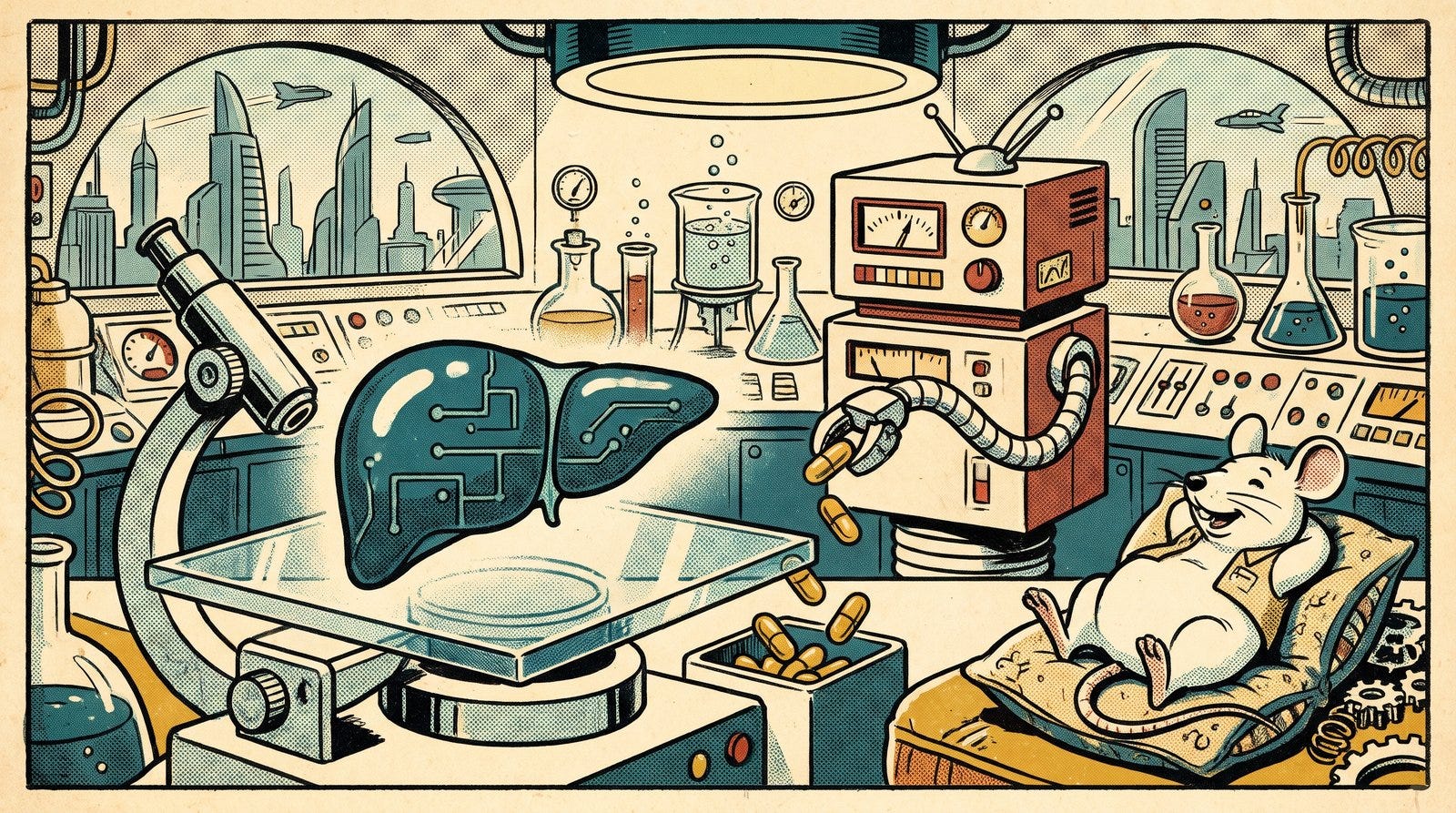
Safer Drugs, Fewer Lab Mice: Lab-Grown Human Livers Are About to Screen AI-Designed Medicines A San Diego company, VivoSim Labs, says its lab-grown human liver tissue spotted liver-damaging drugs correctly 91% of the time across 92 drugs whose effects were already known, and it is about to start screening brand-new molecules designed with A.I. by its partner, Chemveda Life Sciences. Those numbers are the companies' own. The idea is a tighter loop: design a drug, test it on human tissue in about two weeks, and fix it while that is still cheap.
Why it matters: test subjects that are neither people nor animals could speed up almost every drug and therapy timeline we track, and the first joint tests are expected this quarter. Our odds on when animal tests start giving way are in the full post. Read it →
Yesterday on the site
The End of Aging
Deep Sleep Could Flag Alzheimer's Early: “Lonely” Brain Waves Track the Tangle Protein: a UC Berkeley study tied the tangle protein tau to deep-sleep waves that travel less far, and to worse overnight memory; a correlation, not yet a test.
Stopping Muscle From Turning to Fat: A Pill Trial in 53 Boys Reports by Early 2027: Satellos switched its Duchenne pill trial in 53 boys to an MRI measure of thigh-muscle fat, with placebo results due in the first quarter of 2027.
A Longevity Drug Boosted Brain Blood Flow in People With the Top Alzheimer's Risk Gene: four weeks of low-dose rapamycin improved brain blood flow in healthy carriers of the APOE4 risk gene aged 45 to 65, in a small pilot with no placebo group.
A Face-Lift in a Jar? A Black Ginger Cream Plumped Hollow Cheeks in a 35-Person Test: in a 35-person open pilot, a black ginger and safflower oil cream added volume to hollow spots on the face.
Superhuman
One Gene Shot to Save Failing Eyesight: All 13 Measured Patients Saw Better, Its Maker Says: VeonGen says the FDA agreed the design of a pivotal trial for its Stargardt disease gene therapy; its early results are a company claim.
To the Stars
The First Moon Base Gets Delivery Trucks and a Nuclear Rover to Dig for Ice: NASA qualified eight companies for up to $10 billion in Moon deliveries over 10 years and hired Blue Origin to land a nuclear-powered, ice-drilling rover, targeted for late 2028.
Bezos's Moon Rocket Gets 12% More Muscle and a Third Stage Built for Deep Space: New Glenn shows a stronger booster engine and a third stage booked for a 2028 mission (secondary report).
Mining the Moon for Profit: Europe Is Building the Math on What's Worth Hauling Home: three European teams will model whether Moon resources pay, down to the break-even haul a helium-3 miner needs.
Spaceports Like Airports: The FAA Is Planning for a Rocket Launch Every Hour: the FAA projects 10,000 licensed launches and reentries a year by 2035 and has proposed rules to get there (not yet in force).
Robots & Self-Driving
Robotaxis in 20 Cities by 2027: Uber Bets $10 Billion on a Driverless Fleet: Uber says it will spend $10 billion for 2,000 robotaxis in about 20 cities by the end of 2027.
Teach It Once, Then It Works Alone: A Factory Robot Hit 98% a Month After Training, Its Maker Says: a Swiss start-up says its rolling humanoid takes over a task about a month after remote-control training and hit 98% in one factory test.
Limitless Energy
Cheaper Nuclear Power Starts With Fuel That Lasts Longer. A U.S. Plant Just Made It.: Urenco USA says its New Mexico plant made the West's first commercial batch of the higher-enriched fuel many small reactors need; the first order ships spring 2027.
Also new
Designer Proteins on Demand: An AI Turns Plain-English Requests Into Working Molecules: Westlake University's Pinal writes proteins from typed requests; 5 of 20 carbon-shuttle designs worked in lab tests.
Nanobots Just Got an Engine: A Molecule-Sized Screw That Spins on Electricity: a spiral molecule a few nanometers across spins under electric current, a lab building block for future nanomachines.
Drone-Zapping Lasers Are Leaving the Test Range: a truck-mounted counter-drone laser was photographed near Mar-a-Lago and Germany ordered an airborne laser pod demonstrator (secondary reports).
By the numbers
91%: how often VivoSim says its lab-grown liver tissue correctly flagged liver-damaging drugs, across 92 known drugs (company claim).
2,000: the robotaxis Uber says it will put in about 20 cities by the end of 2027, for $10 billion.
10,000: licensed launches and reentries a year the FAA projects by 2035.
98%: the score a Swiss rolling humanoid hit in one customer's factory test a month after training, its maker says.
New on the odds board
Yesterday's posts put fresh odds on deep sleep as an early Alzheimer's flag, a muscle-repair pill, rapamycin for the aging brain, a face cream that refills hollow cheeks, a one-time gene fix for sight loss, a nuclear rover on the Moon, New Glenn's comeback, Moon-mined helium-3, a launch every hour, Uber's robotaxi fleet, robots that work alone after one lesson, fuel for small reactors, proteins written from plain English and molecular motors for nanomachines. Every milestone lives on the calculator.
On the calendar
This quarter: the first VivoSim and Chemveda tests of A.I.-designed drug candidates on lab-grown human liver tissue (company plan).
January 2027: the target, per an internal memo reported secondhand, for New Glenn to return to flight.
First quarter of 2027: placebo results from Satellos's 12-week Duchenne pill trial in 53 boys.
Spring 2027: Urenco USA's first order of higher-enriched reactor fuel ships.
End of 2027: Uber's target for 2,000 robotaxis in about 20 cities.
Late 2028: the launch target for Blue Origin's nuclear-powered, ice-drilling rover.
The story we're following
The Moon base is getting its supply chain. In one day we covered NASA lining up eight companies for up to $10 billion in Moon deliveries plus a nuclear rover to dig for ice, a stronger New Glenn with a third stage built for deep space, European teams working out which Moon resources are worth hauling home, and an FAA planning for a rocket launch every hour. Trucks, fuel, mining math and traffic rules are the unglamorous pieces that turn a landing site into a place people can stay.
Quote of the day
"Earth is the cradle of humanity, but one cannot live in the cradle forever." — Konstantin Tsiolkovsky, the Russian rocket pioneer, in a 1911 letter. Yesterday NASA lined up the delivery trucks and a nuclear rover for the first Moon base.
Coming up
Already up this morning: an exercise pill headed into people, robot butlers that learn by watching human video, federal money for fusion plants that run for years and an Air Force bet on Joby's self-flying software. Still to come today: ray guns against drone swarms at 10 a.m., old muscles that haven't forgotten how to heal at 11, DIY 3D displays at noon, a robot butler anyone can build at 1 p.m., India's plan for zero new space junk at 3, Dutch hyperloop trains at 5 and a sleep hormone that brought color back to gray hair at 7.
Until next time
That's today in the future. If someone you know would want to wake up to this, forward it to them, and if you're reading a forward, subscribe here. It's free every morning.