


Sunday, Nov. 1, 2026 · about a 5-minute read
Good morning. The clocks fell back overnight, so everyone got an extra hour. Fitting, because today's big one is about getting back something most people assume is gone for good: a little more height.
The big one
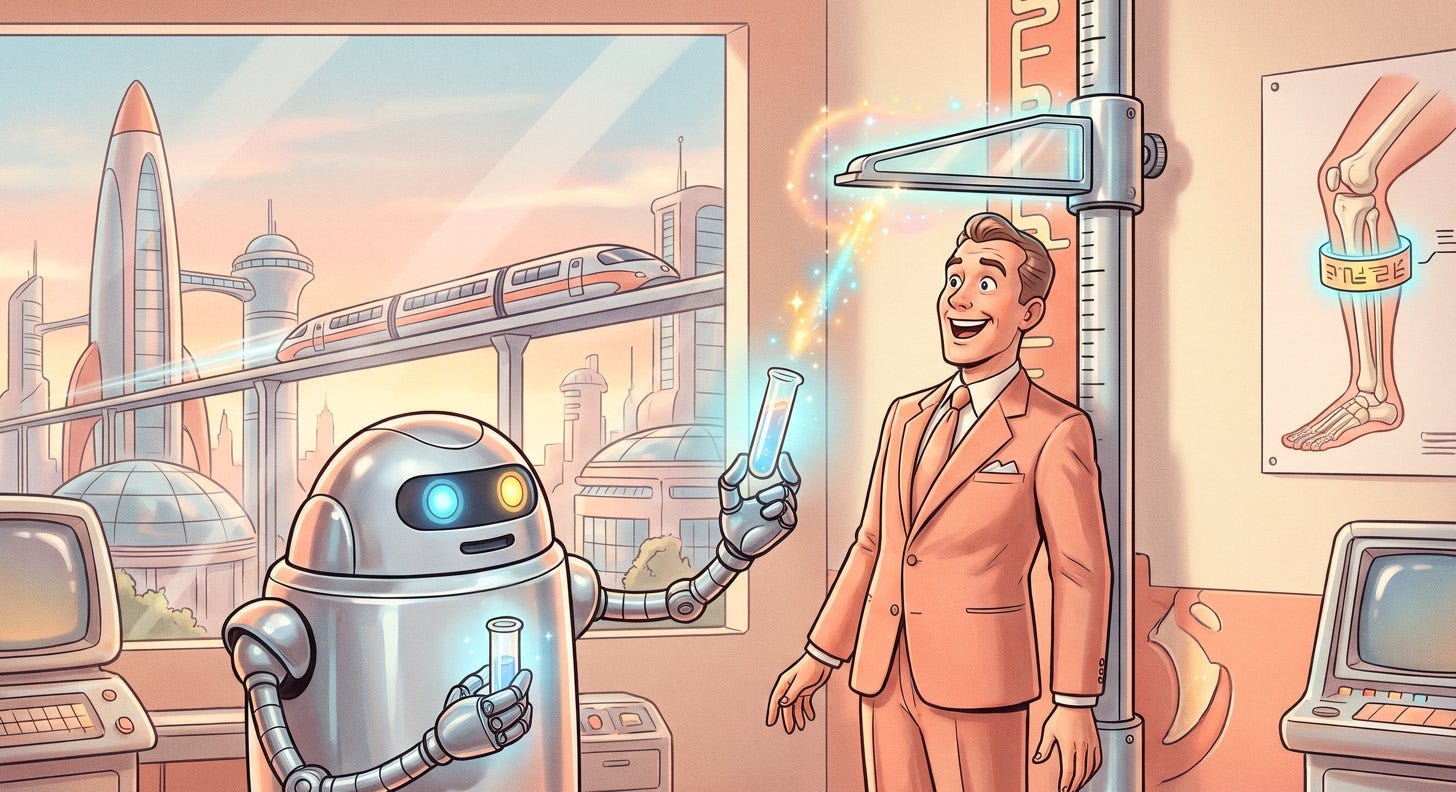
Grown-ups growing taller? Science now has the parts list. Once growth plates close, the only way to add height is surgery that breaks a leg bone and stretches it, about 2 to 3 inches with a year or more of recovery. But every part of a different machine now exists somewhere. A 2026 Karolinska map found dormant, stem-like cells inside human growth plates. Three drugs that turn up the plate's own "grow" signal are approved or before the FDA for children with growth disorders. The first age-reversal therapy has been tried in people, and Stanford regrew real joint cartilage in old mice last month.
Why it matters: nobody has reopened a closed growth plate in any animal, but adult height has moved from fantasy to an engineering problem with a bottleneck you can name. It's Some Assembly Required #4. Read it →
Yesterday on the site
Some Assembly Required
Frankenstein Was Just Early. How the Future Is Being Built by Mad Scientists.: frozen organs, pig kidneys, after-death cell rescue and lab-grown brains add up to a real-life organ bank, not a monster.
The End of Aging
The Speed of Aging May Be Set by the Bugs in Our Gut: if a microbe moves the aging clock, a probiotic or diet could be tested in months, not decades.
Wrinkle Cream, but Make It Mitochondria: Eye Wrinkles Shrank in 8 Weeks: a cream that triggers cleanup of worn-out cell power plants made eye wrinkles shallower.
Superhuman
A Man Who Lost His Voice Is Talking at 75 Words a Minute, Straight From His Brain: if Neuralink's one-man result holds up, people who can't speak could get nearly half of normal conversation speed back.
Robots & Self-Driving
Tesla's Robotaxis Drove 438,000 Miles in Austin in One Week, With No One at the Wheel: a second company is racing Waymo for driverless rides in the same city.
The Fridge Company Is Building a Robot Butler, Due by 2030: an appliance giant has put a year on humanoid helpers in the home.
Limitless Energy
The Nuclear Reactor That Rolls Off an Assembly Line Just Got Its First Real Part: factory-built reactors take a real step from approval toward hardware.
Sci-Fi Tech
Sunglasses With a Movie Theater Inside Just Went on Sale: the first glasses on Google's Android XR platform are on sale from $1,099.
A Coin-Sized Battery Built Just for Brain Implants Packs 40% More Punch: solid-state batteries may show up in people's heads before they show up in cars.
Saturday afternoon and evening
Beating Alzheimer's to the Punch: A $41 Million Trial Will Test Ways to Stop It: a 20-site federal trial will screen five to ten prevention regimens in people with no symptoms yet.
A Simple Blood Draw Could Spot Alzheimer's Before Symptoms Start: the same blood test now cleared for people with symptoms is being lined up to find healthy volunteers for prevention trials.
Getting to Space Could Get Cheaper With One Big Catch: SpaceX's first try at catching both Starship stages reportedly targets Nov. 12 (unconfirmed).
A Pint-Size Nuclear Reactor Could Keep Lights On in Space: defense researchers are funding a nuclear ground test of a small space reactor.
Space Gas Stations Could Run on Sunbaked Asteroids: a company patented cracking asteroids with focused sunlight to make rocket fuel (company claim).
Fusion Plants Could Someday Run Nonstop: radio waves drove part of a fusion plasma's current for the first time, a step toward machines that never pause.
Faster-Than-Sound Flights Could Come Back: the engine meant for a supersonic airliner may power AI data centers first (company claim).
Already up this morning
A Data Center in the Sky Needs Satellites That Share Chores: a start-up says its job-sharing software passed a NASA-funded test, with one real computer in orbit.
A Chore Robot for the Price of a Used Car?: a start-up says a $20,000 two-legged home robot is coming in 2028 and is taking $200 deposits (company claim).
The Pentagon Is Assembling a Brain Trust on Sleep, Hormones and Wearables: a new advisory council will tell the military what actually helps troops perform.
By the numbers
75 words a minute: what Neuralink says a man with ALS reached through its implant in his first week. Ordinary conversation runs about 160 (company claim, one man).
438,000: driverless miles a community tracker counted for Tesla's robotaxis in Austin in a single week, up 30% from the week before (unaudited).
924 megawatts: what 12 of NuScale's factory-built 77-megawatt modules would make together, about one big reactor's worth.
New on the odds board
Yesterday's posts put fresh odds on a speech-restoring brain implant winning U.S. approval, Tesla offering robotaxi rides across the Sun Belt, LG selling a home humanoid, NuScale signing its first binding order, a gut-bacteria treatment slowing an aging clock, and a frozen, rewarmed organ being transplanted into a person. Saturday's posts added odds on catching both Starship stages, a nuclear ground test of a small space reactor, an Alzheimer's prevention treatment for people with no symptoms, and asteroid water sold as rocket fuel in space. Paid readers see the numbers inside each post.
On the calendar
Nov. 4 to 7: the Gerontological Society of America's annual meeting in National Harbor, Md.
Nov. 9: CRISPR Therapeutics presents new human data on its one-dose gene editor for high triglycerides.
Mid-November: XREAL's Aura glasses start shipping, and results arrive for the Xanamem Alzheimer's pill. On Nov. 16, AriBio's AR1001 reports results from 1,535 people.
November, no day set: Starship Flight 15 and the first attempt to catch the ship with the tower. Public FAA meetings on SpaceX's request for more launches run Nov. 17 to 19.
The story we're following
Digital patients: no new development this week. We're still watching for the first regulator to let a computer model stand in for real patients in a final trial.
Quote of the day
"It was never a real contest." — Elon Musk, on Tesla's robotaxis and Waymo, from yesterday's Austin post. Nationally, Waymo still drives about seven driverless miles for every one of Tesla's.
Coming up
Monday's big one: We May Finally Have Found the Fountain of Youth. It Was in a Lab. Some Assembly Required #5 lines up eight parts, from rewinding old cells to clearing zombie cells to swapping worn-out organs, that already exist in early form.
Until next time
That's today in the future. If someone you know would want to wake up to this, forward it to them, and if you're reading a forward, subscribe here. It's free every morning.