


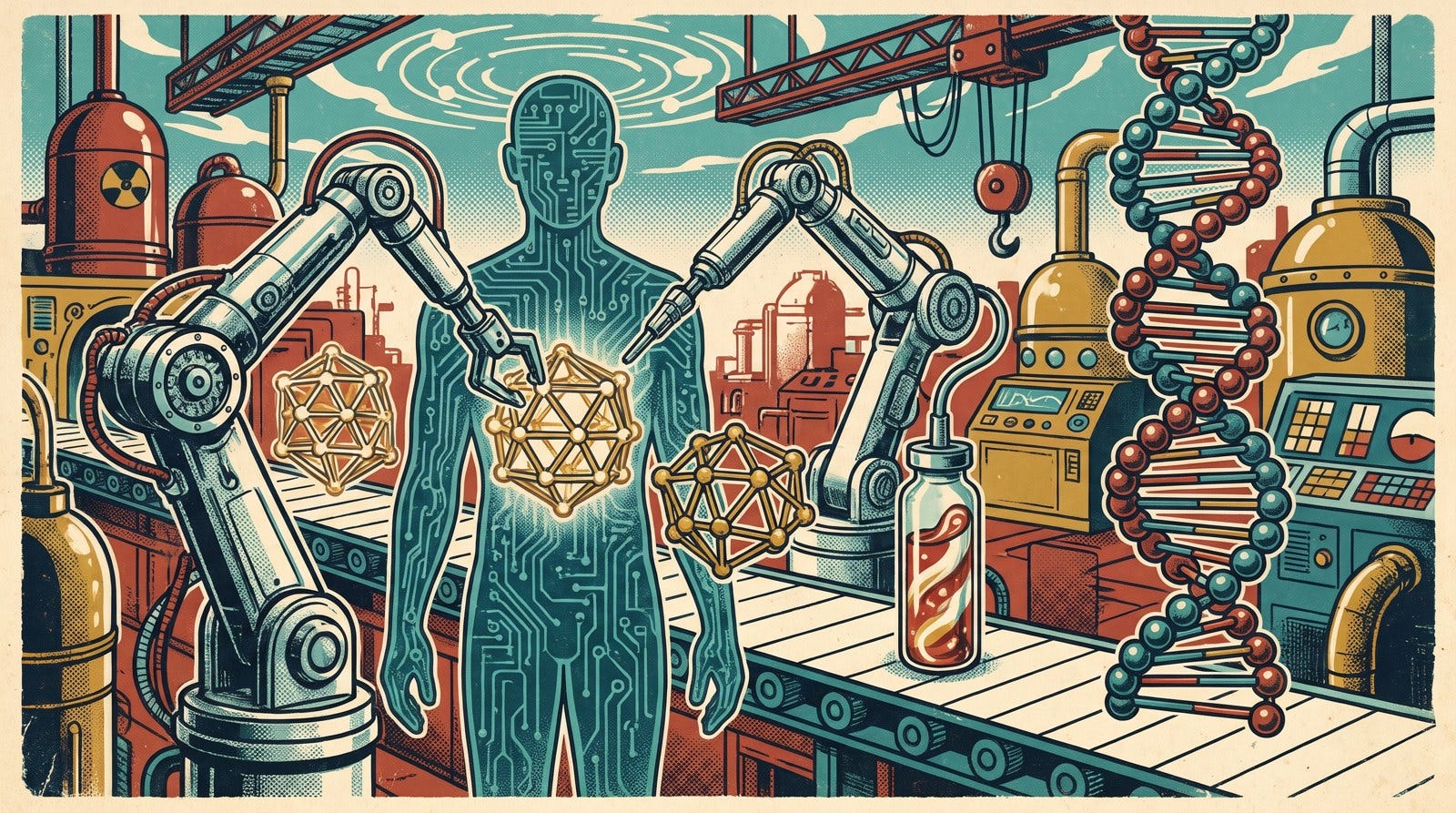
This morning: our second Some Assembly Required, on how the pieces for a cure built in a week already exist. Below it, yesterday's seven stories in one place.
The Week-Long Cure: Medicines Could Be Designed in Days and Tested on a Digital You
Making a new medicine takes more than a decade and up to $2 billion, and more than 9 in 10 candidates fail. Four pieces now exist, each in early form, that could one day squeeze the front of that process into weeks: an AI that designed lab-confirmed toxin-gripping proteins in 64 hours, computer copies of patients meant to forecast a drug's effect before anyone takes it, one-time gene edits that have held for a year, and gene tests that may show whom a pill helps and whom it harms. Snapped together, they would take a lab from a disease to a tested candidate, aimed at the right people, in weeks. For ordinary people that could mean treatments for rare diseases nobody bothered to make, fewer sick volunteers handed a dummy pill, and one dose in place of a lifetime of managing an illness. None of it fixes the slow part: proving in real people that a drug is safe and works.
Yesterday on the site
Your Next Medicine Could Be Tested on a Digital Copy of You First
Testing drugs on digital stand-ins could cut years off trials and spare real patients the placebo. It is now a story we are following. Read it →
Anthropic's IPO Filing Could Put Frontier AI in Ordinary People's Portfolios
For the first time, anyone with a brokerage account could own part of a company building frontier AI, and its finances would be open for all to check. Read it →
AI Designed Venom Blockers in 64 Hours, a First Look at Cures Built in Days
If AI can design treatments in days instead of years, cures for neglected problems like venom could arrive far faster. Read it →
Driverless Cars Are Heading for the Suburbs After Waymo Added 250 Square Miles in a Week
Driverless rides are spreading from downtowns to where most people actually live. Read it →
A $1.50 Laser Shot Could Make the Cheap Attack Drone Obsolete
A beam that costs about $1.50 a shot against a cheap drone could change how wars are fought and how cities protect themselves. Read it →
A Pill Restored Some Lost Hearing in a Third of Patients in a Late-Stage Trial
It could become the first drug that brings lost hearing back rather than just protecting what is left. Read it →
Lab-Grown Human Brain Cells Just Helped a Computer Read Braille
Living human tissue is starting to do computing work, which could mean a new kind of computer and hard new questions. Read it →
Odds moved: our odds on driverless rides becoming an ordinary option in big U.S. cities moved yesterday. Paid subscribers see the new number in the Waymo post.
Coming up today on the site, one an hour:
9 AM: Fusion plants that could double as gold mines
10 AM: One infusion that could end a lifetime of inherited kidney stones
11 AM: The race to deliver the first cargo to a permanent Moon base
Noon: Hiding from heat cameras, now in three dimensions
1 PM: A gene test that could tell whether aspirin protects the brain from dementia
And more through the afternoon
Our odds on every story are dated and never quietly rewritten.