

Monday, Nov. 2, 2026 · about a 5-minute read
Good morning. For centuries the fountain of youth was a place you had to find. Today's big one argues it is a kit you have to assemble, and that every piece of the kit now exists somewhere.
The big one
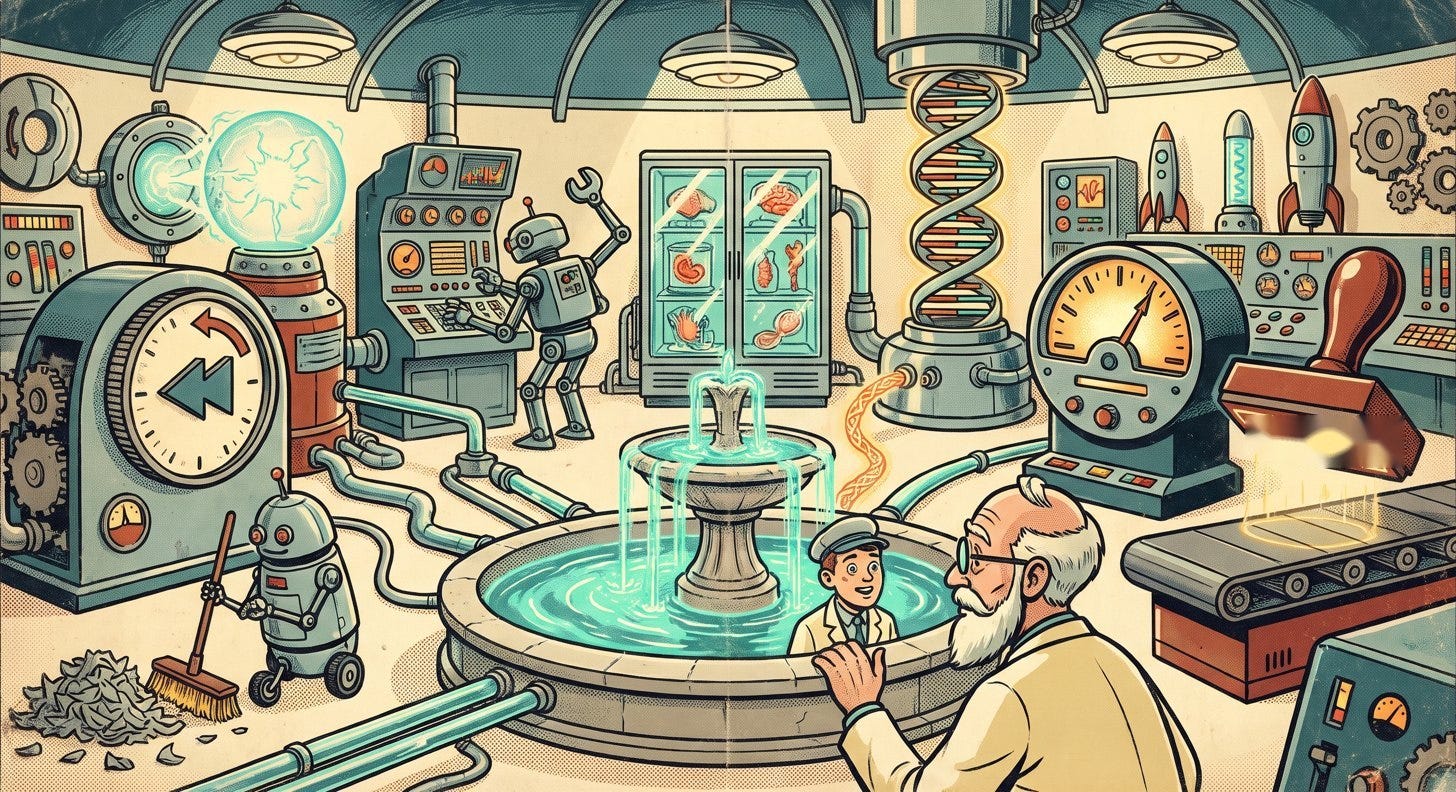
We may finally have found the fountain of youth. It was in a lab. A therapy built to turn old cells young has been injected into human eyes and cleared for a dose three times higher. Cheap pills that clear aging "zombie" cells reversed liver scarring in a placebo-controlled trial. A compound restarted the immune system's training organ in old mice. Pig kidneys are carrying people to human transplants, one-time gene edits are holding for a year, and the FDA has started describing what an anti-aging drug would have to prove.
Why it matters: nobody has bolted these parts together, and none has reversed aging in a controlled human trial, but the list of what is missing has become short and specific. It's Some Assembly Required #5, with all eight parts, how they could snap together, and the odds for the whole machine. Read it →
Yesterday on the site
Some Assembly Required
Grown-Ups Growing Taller? Science Now Has the Parts List: dormant growth cells, new growth drugs and the first age-reversal therapy in people put adult height on the engineering table, with one named bottleneck.
The End of Aging
A New Aging Clock Reads the Cell's Recycling Bins, and Eating Less Slowed It in Animals: a new kind of gauge reads aging in the chemistry of the cell's cleanup compartments, in animals so far.
Why Do Some Dogs Age Like Champions? A $29 Million Hunt Could Help People Too: NIH is backing five more years of tracking nearly 55,000 pet dogs to learn why some stay young, per one trade report.
The End of Disease
A Blood Test Can Now Put a Five-Year Number on Alzheimer's Risk: in 2,684 symptom-free older adults, a very high result meant about a 4-in-10 chance of decline within five years.
Scientists Found a Way to Turn Genes Up Without Cutting DNA. It Worked in Mice.: a compact tool raised target genes four- to sevenfold in mice without cutting DNA, small enough for one standard gene-therapy carrier.
Superhuman
The Pentagon Is Assembling a Brain Trust on Sleep, Hormones and Wearables for Its Troops: up to 20 outside experts on hormones, sleep and wearables get a standing seat, though the council names no drug or program.
Thinking Machines
Satellites Try Splitting the Chores, a First Step Toward Data Centers in Orbit: a start-up says its job-sharing software passed a NASA-funded test, with one real computer in orbit and three simulated.
Robots & Self-Driving
A Chore Robot for the Price of a Used Car Is Taking $200 Deposits: a New York start-up prices its two-legged home robot at $20,000 for 2028; every detail is a company claim.
Toyota Will Build Waymo Robotaxis Ready to Drive Off the Line, Starting in Japan: building the self-driving hardware in at the factory could ease the car shortage that limits driverless rides.
Limitless Energy
A Mini Nuclear Plant Just Cleared a Safety Hurdle and Lined Up Its Fuel: the Energy Department approved the safety basis for a factory-size reactor, and its fuel maker is lined up for a 2027 run.
Sci-Fi Tech
NASA's Quiet Supersonic Jet Just Crossed the Country. Next: Thumps Instead of Booms Over Towns.: the X-59 made its first long trip, but the town flights that could end the overland supersonic ban still have no date.
The Army Has Laser Weapons at the Border. Now Comes the Hard Part: Fixing Them in the Field.: the Army's drone-killing lasers are in the field; whether soldiers can keep the optics clean and working is the next test.
Already up this morning
Brain Tumors Grown in Space Act More Like the Real Thing, a Better Test for Cancer Drugs: mini-tumors grown 40 days on the space station looked more like patients' aggressive tumors, per a Notre Dame study.
A California Factory Is Making Grid Batteries That Skip Lithium and Shrug Off the Cold: a GM-backed start-up says its Sacramento plant should near a gigawatt-hour of sodium batteries in 2027 (company claims).
Robot Butlers Could Get Meta's AI as a Brain. A China-Built Prototype Reportedly Exists.: Meta reportedly built a five-foot humanoid with a Chinese robot maker and calls it internal research.
By the numbers
About 38%: the chance of measurable impairment within five years for symptom-free older adults with very high blood p-tau217, in a JAMA study of 2,684 people. It is a group risk, not a forecast for any one person.
$29 million: what NIH is putting into five more years of the Dog Aging Project, per one trade report; the NIH release was not found.
1973: the year the U.S. banned supersonic flight over land, the rule NASA's X-59 is meant to give regulators a reason to lift.
New on the odds board
Yesterday afternoon's posts put fresh odds on a p-tau217 blood test being cleared to screen people without symptoms, a public driverless Waymo ride in Tokyo, the FDA accepting a biological-age test in aging trials, Antares running its Mark-1 reactor for six months, a gene-activating therapy reaching patients, the X-59 flying over U.S. towns, the Dog Aging Project explaining why some dogs age well, and laser drone defense in routine Army use. The morning's posts added satellites sharing computing jobs, Tuesday Labs delivering its robot and the Pentagon council's first meeting. Today's Fountain of Youth post puts odds on the whole machine. Paid readers see the numbers inside each post.
On the calendar
Nov. 4 to 7: the Gerontological Society of America's annual meeting in National Harbor, Md.
Nov. 9: CRISPR Therapeutics presents new human data on its one-dose gene editor for high triglycerides.
Nov. 16 to 19: the Clinical Trials on Alzheimer's Disease conference in Boston, with Phase 3 results for AriBio's pill AR1001 and new Biogen data on a tau-lowering drug.
The story we're following
Alzheimer's before symptoms: in three days we've covered a $41 million federal prevention trial, a blood draw headed for people who feel fine, and a blood test that puts a five-year number on risk. The missing piece is a treatment for people who test high. The next results arrive at the Alzheimer's trials conference in Boston, Nov. 16 to 19.
Quote of the day
"The best way to predict the future is to invent it." — Alan Kay, computer scientist, at a 1971 Xerox PARC planning meeting. A year later he sketched the Dynabook, a book-sized personal computer that looks a lot like the tablets and laptops we carry now.
Coming up
Tuesday's big one: A Vaccine Against Aging Itself? Old Mice That Got One Lived 12% Longer. A shot that trains the immune system to hunt worn-out "zombie" cells raised old mice's median lifespan, and we look at how far that is from people.
Until next time
That's today in the future. If someone you know would want to wake up to this, forward it to them, and if you're reading a forward, subscribe here. It's free every morning.