



FREE READ. This one is on the house: the full story, the Odds board and the speculation, open to everyone. Most posts are free through the TL;DR only.
TL;DR
Power bills were on the ballot Tuesday, and voters handed the AI build-out a new set of rules. In dozens of towns, people voted to limit, ban or put conditions on new data centers, and across races for governor, utility regulator and Congress, candidates of both parties ran on the same promise: data centers should pay their own way, bring their own power and stop passing grid costs to households. For families, the aim is steadier electricity bills after years of increases; for the country's AI ambitions, it points to a build-out that keeps going on new terms, with the pressure falling on adding power plants faster. The fastest lever is a federal law making big data centers cover their own grid upgrades, which has already passed the House 417 to 3. Our odds: an 85% chance it becomes law, and 50% that it happens by the end of 2027. For the full odds and a timeline of every breakthrough on the way, subscribe.
Where it stands
The ballot measures
Voters decided 41 local data center measures in 10 states on Nov. 3, by Ballotpedia's count; none was statewide. As of late Tuesday, 33 measures restricting data centers had passed or were leading, about a dozen more had no totals yet, and one measure, in North Dakota, went in favor of building, per Stateline, citing the Data Centers on the Ballot tracker (secondary report). In an NBC exit poll Stateline cited, 56% of voters called AI and data centers a "crucial or major factor" in their vote for Congress.
Ohio results, as reported by the Cincinnati Enquirer (updated 12:15 a.m. ET Wednesday) and local outlets:
Bans passed: Hubbard, Sunbury, Pataskala, Urbana, Defiance, Upper Sandusky, Piqua, Granville, Conneaut and Trenton, where Issue 17, a ban on data centers using over 25 megawatts, drew about 80% yes.
Pataskala: 5,418 yes to 1,941 no (73.62%), preliminary and before absentee ballots, as of 10:28 p.m. ET, per The Reporting Project.
Ashville: 1,468 to 330 (81.65%) to reverse the village's agreement with EdgeConneX for two data centers, with all four precincts in, per the Scioto Post at 9:39 p.m. ET.
Grove City: 55% to require a public vote on large developments, including those using over 20 megawatts or 500,000 gallons of water.
Perry: over 87% to require financial guarantees from developers who seek tax breaks.
Wilmington: about 80% against the rezonings in all four referendums.
Oregon voters approved a 25-megawatt cap on data centers with 60% of the vote, per 13abc (4:22 a.m. ET Wednesday). Not yet reported in Ohio as of late morning Wednesday: Monroe and Sprigg Townships, and Monroeville.
Elsewhere, no totals found in the sources we checked as of late morning Wednesday: Alhambra, Calif. (a citywide ban); Edgewater, Fla.; El Dorado, Emporia and Ottawa, Kan.; North Berwick, Peru, Wells and Wiscasset, Maine; Janesville, Wis.; Boulder City, Nev. (a measure to allow data centers); and advisory questions in Illinois.
A statewide Ohio amendment to ban large data centers missed its July 1 signature deadline; its backers are aiming for 2027, per Ballotpedia.
The races that set power rules
Georgia Public Service Commission. Republicans held a 3-2 majority on Georgia's utility regulator going into Tuesday, per Ballotpedia. In District 3, Democratic incumbent Peter Hubbard, who published a study estimating that data center discounts "shift over a billion dollars in infrastructure costs onto residential customers," faces Republican Fitz Johnson, who wrote that "data centers should pay their fair share of the power bill." In District 5, Democrat Shelia Edwards says data centers "must pay the full cost of the infrastructure needed to serve them"; Republican Josh Tolbert says they "should pay their incremental costs" and calls himself "pro-growth, pro-business, and pro-data center"; Libertarian Thomas Blooming is also running.m. ET. The AP called both seats for the Democrats: Hubbard at 10:38 p.m. Tuesday and Edwards at 10:54 p.m., per Fox 5 Atlanta.
Arizona Corporation Commission. Republicans hold all five seats on Arizona's utility regulator; two were on the ballot. Democrat Clara Pratte was leading with 28%, Democrat Jonathon Hill 27%, Republican incumbent Kevin Thompson 22% and Republican Ralph Heap 21%, as of 9 p.m. MST, with the share counted not reported, per KAWC; the race had not been called. Pratte wants big users to pay the full cost of the infrastructure that serves them and Hill wants stricter rules for large loads; Thompson says the commission cannot block data centers and Heap backs their growth while scrutinizing rate increases, per Ballotpedia.
Governors. In Texas, the AP called the governor's race for Democrat Gina Hinojosa over Gov. Greg Abbott at 11:17 p.m. ET, per Scripps News. She led 57% to 42% with 70% counted as of about 1:03 a.m. ET, and Abbott conceded, per the Washington Examiner (secondary report). Hinojosa ran on an emergency pause on new data centers until the Legislature acts, an end to their sales-tax exemption, a ban on secrecy agreements that hide water and energy use, and protection for ratepayers, per her campaign. Abbott, on Aug. 3, ordered the state's utility commission and grid operator to audit data centers seeking a grid connection and froze new approvals until the audit is done: "Simply put, Texans must come first," per E&E News.
In Ohio, the AP projected Democrat Amy Acton the winner over Republican Vivek Ramaswamy, per 13abc; she led 50.7% to 46% with 81% counted, per Newsweek at 10:49 p.m. ET. Acton proposed a "conditional moratorium" under which data centers would pay their own taxes, supply their own energy, use union labor, meet environmental standards and sign community agreements; Ramaswamy said data centers must provide their own energy and cover nearby residents' electricity costs, opposed property-tax breaks for them, and said of the boom, "I'm all for it," per Statehouse News Bureau. Acton's plan would need the Republican-led General Assembly.
In Arizona, Gov. Katie Hobbs, a Democrat, led Republican Andy Biggs 58% to 40% as of 9 p.m. MST; the race had not been called, per KAWC.
Congress
The AP called the Senate for Democrats late Tuesday, per TIME. AP-called winners, per PBS NewsHour, include James Talarico in Texas, who wants data center developers "to fund their own infrastructure upgrades" and questions $3.2 billion in state tax breaks, and Sherrod Brown in Ohio, who made opposition to the facilities central to his campaign, per Newsweek. In Iowa, Josh Turek beat Rep. Ashley Hinson, who stressed American AI leadership to compete with Beijing. Republicans held Florida and Wyoming. The AP then called the House for Democrats early Wednesday, giving the party control of both chambers, per PBS NewsHour (1:27 a.m. ET).
Three AI questions await the next Congress, as TIME laid them out in September:
Ratepayer protection. The House passed the Ratepayer Protection Act 417 to 3 on Sept. 16. It asks states to consider a federal standard under which data centers using 100 megawatts or more cover the grid upgrades needed to serve them, per NACo. Sen. Martin Heinrich, a Democrat, blocked fast Senate passage, saying "it won't do anything to actually force data centers to pay their fair share." A bipartisan Senate package introduced Sept. 30 would directly require data centers of 20 megawatts or more to cover their transmission costs. TIME called a data center energy-cost bill "perhaps the most likely measure" for Congress after the midterms.
State AI laws. Many Republicans and the White House back a federal override of state AI laws. Sen. Maria Cantwell, a Democrat, wrote that "the answer is not a weak federal standard that becomes a backdoor for wiping out stronger state protections."
Chips and China. The Chip Security Act would require advanced chips to carry a way to verify their location. Rep. Bill Foster, a Democrat, said it may ride on the annual defense bill, and Senate Democrats led by Chuck Schumer urged Majority Leader John Thune to bring it and two China tech-export bills to the floor. Industry critics say restrictions push China to build its own chips.
How we got here
U.S. households paid an average of 16.5 cents a kilowatt-hour in 2024 and 17.3 cents in 2025, and the Energy Information Administration projects 18.2 cents in 2026 and 18.7 cents in 2027, in its Oct. 6 outlook. For a home using 1,000 kilowatt-hours a month, that is about $165 a month in 2024 rising to about $187 in 2027, before fees. EIA expects commercial power use, which includes data centers, to grow 2.8% in 2027 while household use stays flat.
The squeeze shows up first in PJM, a regional grid operator that runs an auction years ahead to buy enough power-plant capacity. Its auction for 2027-28, released Dec. 17, 2025, cleared at the $333.44-per-megawatt-day cap, cost about $16.4 billion and came up 6,623 megawatts short of its reliability target. Of a 5,250-megawatt rise in forecast peak demand, nearly 5,100 megawatts came from data centers, about 97%. PJM's Stu Bresler said the auction "leaves no doubt that data centers' demand for electricity continues to far outstrip new supply." The next auction, for 2028-29, reported July 14, 2026, cleared at its $325 cap, again cost $16.4 billion, and came up 6,831 megawatts short, with forecast demand up 1,374.5 megawatts, "largely due to additional Large Loads."
In April, Port Washington, Wis., near a $15 billion OpenAI and Oracle project, voted about 2 to 1 to require voter approval of tax breaks, per Canary Media.
What's next
Nov. 4 onward: counting continues in the House, the Senate races in Maine and Michigan, the Arizona Corporation Commission, Georgia's commission races and the uncounted local measures.
Week of Nov. 9: Congress returns for its post-election session, per Harbinger Strategies and Reed Smith.
Dec. 1: a runoff for Georgia's District 5 commission seat if no candidate won a majority, per Ballotpedia.
December 2026: PJM's auction for 2029-30, against a forecast peak of 171,916 megawatts, up 3.6% from the last auction's forecast, per PJM.
Week of Dec. 7: the target for a final defense bill on the floor, a possible vehicle for the Chip Security Act, per Harbinger.
Dec. 11: current federal funding runs out, per Harbinger.
2027: Ohio's ban amendment backers aim for that year's ballot.
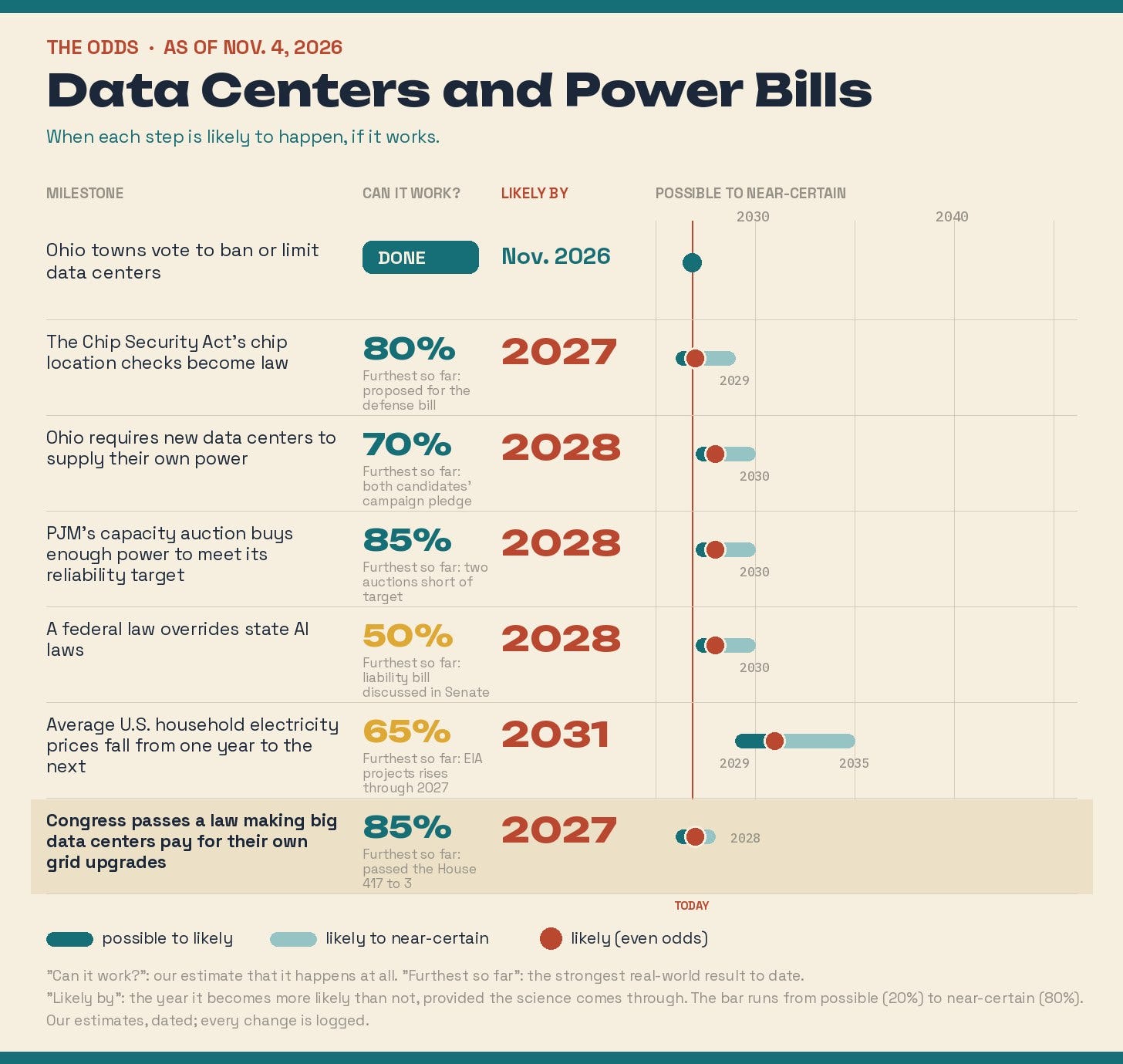
The odds (as of Nov. 4, 2026): Congress passes a law making big data centers pay for their own grid upgrades: chance it works 85%; likely by 2027, provided the science comes through.
The Odds (as of Nov. 4, 2026)
Why these odds
As of Nov. 4, 2026. For each milestone: the chance it ever happens, and the year it becomes more likely than not, provided the science comes through.
Congress passes a law making big data centers pay for their own grid upgrades: chance it works 85%; likely by 2027 (50% by 2027). The House passed its version 417 to 3 and a bipartisan Senate package goes further; senators split on whether the House bill is strong enough.
Ohio requires new data centers to supply their own power: chance it works 70%; likely by 2028 (35% by 2028). Both Ohio candidates for governor said data centers should supply their own energy, but the winner's plan needs the Republican-led legislature.
PJM's capacity auction buys enough power to meet its reliability target: chance it works 85%; likely by 2028 (40% by 2028). The last two auctions cleared at the price cap and came up about 6,600 and 6,800 megawatts short; the next one, in December, faces a forecast 3.6% higher.
Average U.S. household electricity prices fall from one year to the next: chance it works 65%; likely by 2031 (25% by 2030). EIA projects prices rising every year through 2027, to 18.7 cents a kilowatt-hour, while data center demand keeps growing.
The Chip Security Act's chip location checks become law: chance it works 80%; likely by 2027 (45% by 2027). Backers in both parties want it on the defense bill, which is aimed at the floor the week of Dec. 7; the Senate has not passed a defense bill yet.
A federal law overrides state AI laws: chance it works 50%; likely by 2028 (15% by 2027). Many Republicans and the White House back it, while key Democrats who now lead the Senate oppose a weak federal standard that wipes out state rules.
Putting it together (speculation)
Outside the towns that voted for bans, the message of the night was not "stop building." Candidates in both parties said nearly the same thing: build, but pay the grid's bill and bring new power along. If that becomes the rule, the cost of a new data center shifts from neighbors' bills to the developer's balance sheet, and the fastest way for a company to get its project approved becomes adding new supply, whether a gas plant next door, a nuclear deal or batteries. That matters for the race with China, a race for computing power as much as for chips. PJM's last two auctions came up about 6,600 and 6,800 megawatts short; developers who show up with their own megawatts would be closing that gap rather than widening it. Speculation: by the late 2020s, bringing new power could be the standard ticket to build, and the measure of America's AI lead could be how many new power plants came with it.