

FREE READ. This one is on the house: the full story, the Odds board and the speculation, open to everyone. Most posts are free through the TL;DR only.
TL;DR
Cancer treatment is starting to move out of the lab and into the syringe. Today's CAR-T therapies, which turn a patient's immune cells into cancer hunters, cost roughly $400,000 to $500,000 and take weeks of custom manufacturing. A new approach does the engineering inside the body with a single injection, and in its first four myeloma patients one version cleared every detectable trace of the cancer within a month. If it holds up, one of the most powerful and most expensive treatments in medicine could become something closer to an ordinary shot. The catch is safety: in another early trial, all five patients had a serious side effect and one died, and fewer than a dozen people anywhere have results.
Where it stands
CAR-T therapy gives a patient's T cells, the immune cells that kill infected or cancerous cells, an engineered receptor called a CAR that locks onto cancer. Seven CAR-T therapies are approved, at roughly $400,000 to $500,000 each, and every dose requires weeks of lab work outside the body. In vivo CAR-T skips the factory: an injected carrier delivers the instructions, and the patient's own cells become the treatment. None had been approved anywhere as of July 24.
The human evidence is small and striking. Kelonia's KLN-1010 cleared detectable myeloma in all four of its first patients within a month, reported in December 2025. Three had a mild-to-moderate inflammatory surge common with CAR-T, none had nerve toxicity, and all skipped the chemotherapy that usually comes first. In June, Legend Biotech said every patient at its higher dose responded in B-cell lymphoma, without saying how many patients that was.
AstraZeneca's ESO-T01 is the warning. In results reported March 27, 4 of 5 heavily pretreated myeloma patients in China responded and 3 reached deep remission by day 60. But all 5 had a serious, hospital-level side effect, 3 had a severe inflammatory surge, and one died on day 19 from a tumor pressing on the spinal cord; the authors could not rule out the cancer itself as the cause. Umoja expected to treat its first U.S. patient in the third quarter; whether it has is unconfirmed.
In the lab, the tools are getting sharper. A UCSF team led by Justin Eyquem, publishing in Nature, built a two-particle shot: one particle carries gene-editing tools and grabs onto T cells, the other carries the DNA for the CAR and slots it into a precise spot in the genome. In mice with humanized immune systems, one injection made all detectable leukemia disappear in nearly all animals within two weeks, and in some organs up to 40% of immune cells ended up engineered. It also worked against myeloma and a solid tumor model. The authors say it still needs scaling up and human trials, and have founded Azalea Therapeutics to commercialize it. "I think this is just the beginning of a big wave of new therapies," Eyquem said.
Researchers are also building ways to control the cells once they are in the body. A team led by the Walter and Eliza Hall Institute in Melbourne reported in the journal Blood a drug-controlled switch. Using prime editing, a precise form of gene editing, they made human T cells resistant to tacrolimus, a common anti-rejection drug, while leaving them sensitive to a related drug, cyclosporin. A patient on tacrolimus would keep the engineered cells working; switching to cyclosporin would hold them back. The method worked in CAR-T cells and in cells from patients with a rare blood cancer. No sample sizes were released. Co-senior author Dr. Tom Lew said the approach "is built around medicines that are already part of routine clinical practice."
A third line of work steers the cells physically. A Science Advances paper describes natural-killer cells, another kind of tumor-killing immune cell, given a cancer-targeting CAR and loaded with magnetic nanoparticles so an outside magnetic field can move them as a swarm. In mice with cancer spreading along the membranes of the brain and spinal cord, the cells were guided up the spinal canal, and imaging confirmed the navigation worked in a monkey. A research digest's summary gives no dose, group size or survival figures, so whether the swarms kill tumors is unconfirmed.
Meanwhile the money is drying up for the older route to cheaper CAR-T, off-the-shelf cells made from donors. On Oct. 7 Caribou Biosciences said it is halting both of its off-the-shelf programs, including vispa-cel for lymphoma, which already had an FDA-agreed Phase 3 design. It blamed the financing climate, not the science. Its shares fell about 39% overnight, to $0.68.
How we got here
December 2025: Kelonia reported KLN-1010 cleared detectable myeloma in its first four patients.
March 27, 2026: AstraZeneca's ESO-T01 results: strong responses, serious side effects in every patient, one death.
June 2026: Legend Biotech reported responses in every higher-dose lymphoma patient.
July 24, 2026: Still no in vivo CAR-T approved anywhere.
October 7, 2026: UCSF published its one-shot method in mice; the same day Caribou halted its off-the-shelf programs.
October 19, 2026: Magnet-steered CAR-NK swarms were reported navigating in mice and a monkey.
October 20, 2026: WEHI reported its drug-controlled switch for engineered cells.
What's next
None of the next steps has a firm date:
Whether Umoja has treated its first U.S. patient.
WEHI's first-in-human trial of its switchable cells.
Human trials of the UCSF method through Azalea Therapeutics.
Whether Caribou finds a buyer, and whether vispa-cel's Phase 3 is ever run.
Tumor-killing data, and any human test, for magnet-steered swarms.
The questions that decide the field: whether the ESO-T01 death was caused by the therapy or the cancer, whether in vivo CAR-T will actually cost less than the lab-made kind, and whether investors who walked away from Phase 3-ready donor-cell programs will fund this instead.
The odds (as of Oct. 25, 2026): An in vivo CAR-T therapy is approved anywhere by 2030: 35%. Our estimate: the early responses are remarkable, but the evidence is fewer than a dozen patients and one trial had a death.
The Odds
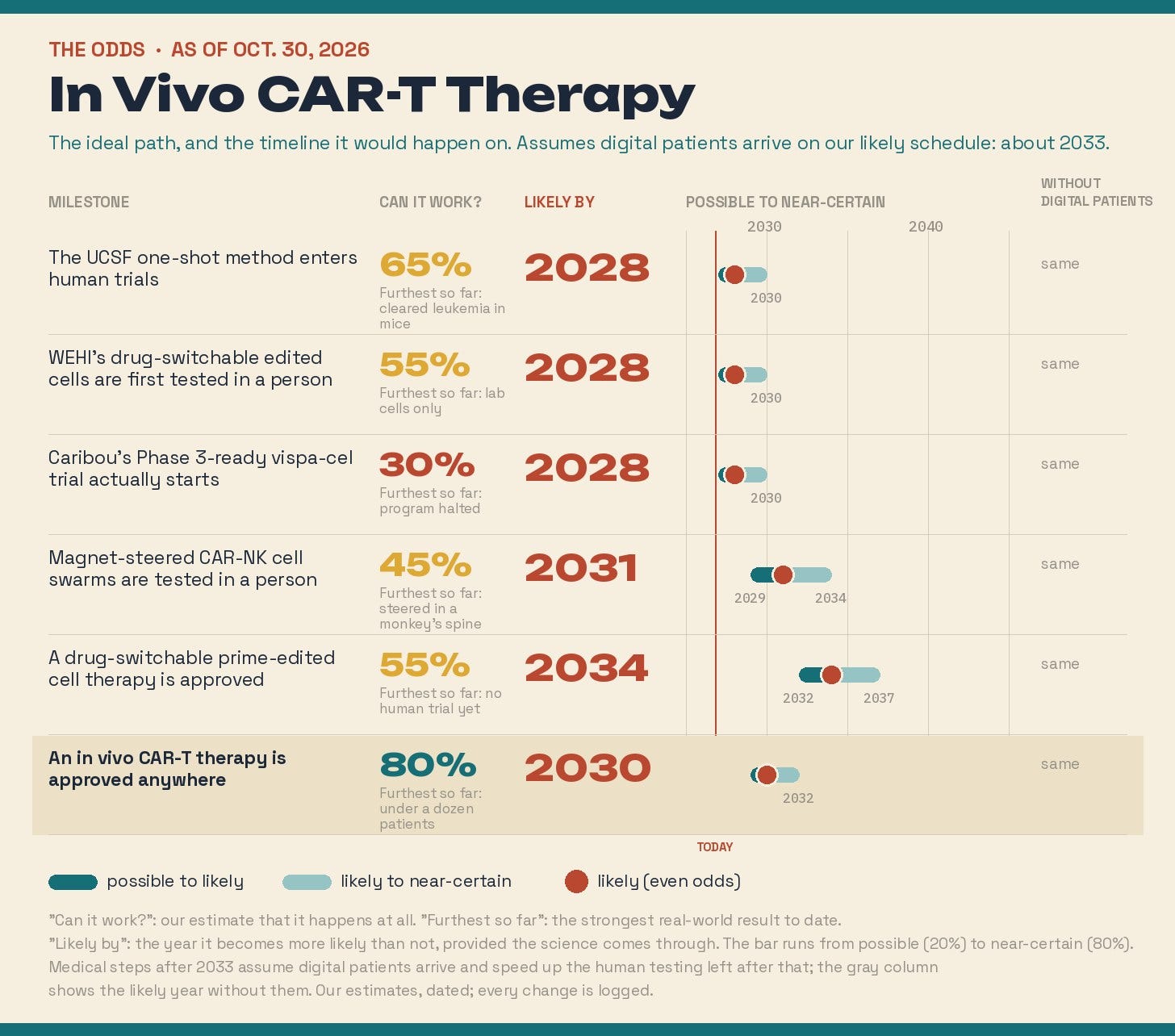
Note, Oct. 30, 2026: We overhauled how we present our odds to make them clearer. Every number we previously published still stands; the chart adds when each step is likely and how much faster it could come with digital patients.
Why these odds
These are our estimates, dated Oct. 25, 2026. They move only on new reporting, and every move is logged.
The UCSF one-shot method, through Azalea Therapeutics, enters human trials by 2028: 35%. It cleared leukemia in nearly all treated mice, but the authors say it still needs scaling up and no trial date has been given.
WEHI's drug-switchable prime-edited cells are first tested in a person by 2028: 30%. The team says it is working toward a first-in-human trial, but the work is in lab cells only and the release gave no sample sizes or editing rates.
Caribou's Phase 3-ready vispa-cel trial actually starts by 2028: 15%. The design is FDA-agreed, but the company has halted the program, is cutting staff and is looking for a merger or sale.
An in vivo CAR-T therapy is approved anywhere by 2030: 35%. One reasonable estimate puts this around 2030, with a range of 2029 to 2034; responses have been striking, but fewer than a dozen patients have results and AstraZeneca's trial had serious side effects in all five patients and one death.
Magnet-steered CAR-NK cell swarms are tested in a person by 2030: 15%. They navigated a monkey's spinal canal, but no tumor-killing figures have been reported and no human date is set.
A drug-switchable prime-edited cell therapy is approved by 2036: 35%. One reasonable estimate puts this around 2036, with a range of 2033 to 2042; prime editing already works in patients, but this switch has no human trial yet.