



FREE READ. This one is on the house: the full story, the Odds board and the speculation, open to everyone. Most posts are free through the TL;DR only.
TL;DR
Atomic rockets were a staple of the old future, and one is finally being built. NASA's SR-1 Freedom, billed as the first fission-powered interplanetary spacecraft, has a uranium reactor under construction in Idaho and a launch date of December 2028, bound for Mars. It will not get there faster than today's rockets; its point is power far from the Sun, where solar panels stop working well. A private company now has $161 million from the Space Force to test its own space reactor on the ground. Fusion rockets, which promise Mars in four to five months, are still pitch decks and lab rigs. If SR-1 works, reactors could become the standard engine room for deep space, and the long trip outward would stop depending on sunlight.
Where it stands
Every trip to Mars is still chemical, taking about 7 to 9 months. There are two ways a nuclear rocket could change that. Nuclear thermal propulsion uses a reactor's heat to drive gas out the back, the faster approach. Nuclear electric propulsion uses a reactor to make electricity that ionizes gas and pushes it out magnetically. Its thrust is very low but efficient, says the Department of Energy's Sebastian Corbisiero: the ship pushes gently for a long time rather than hard for a few minutes.
The U.S. bet on the thermal route ended in mid-2025, when DARPA and NASA cancelled DRACO, a reactor-heated rocket meant to fly around 2027, because cheaper launches shrank its advantage and test costs ran high. DARPA's deputy director called nuclear electric "probably a more optimal long term solution."
That is the route SR-1 Freedom takes. Announced in March, it is uncrewed and will launch on a Falcon Heavy. NASA's mission page, updated Oct. 8, lists a 20-kilowatt uranium reactor, roughly one fifty-thousandth of a typical power plant on Earth, a 12,000-kilogram craft, about 26,000 pounds, and a Hall-effect electric thruster. It will carry three helicopters of the Ingenuity class to Mars. The reactor is being built at Idaho National Laboratory, with NASA Glenn developing the power module, and it would switch on about two days after launch. Assembly and testing run through October 2028, per the American Nuclear Society. The craft is set to reach Mars about a year after launch.
Electric thrust makes the trip longer than a chemical one. Project manager Lindsay Kaldon explains the case for it anyway: beyond the Sun's reach, "you start losing the ability to have effective solar panels." MIT Technology Review puts the cost at about $2 billion. NASA program director Steve Sinacore says integration is progressing steadily.
The record is thin. The U.S. has spent more than $20 billion over 60 years on nuclear-flight programs, and the only reactor it flew, SNAP-10A, died after 43 days. Lindsey Holmes of Analytical Mechanics Associates calls the timeline aggressive and suspects competition with China and Russia is partly driving it. Simon Middleburgh of Bangor University says surviving launch vibration is a serious challenge, since the reactor must ride a rocket before it ever runs.
A private reactor is coming up behind. Antares won a $161 million Space Force award to run a nuclear ground demonstration of its R1-S space reactor before flight certification, and to operate its Mark-1 reactor for more than six months in 2027, per the company release. Its smaller Mark-0 reached criticality, a self-sustaining chain reaction, on June 4 at Idaho National Laboratory. The release gives no power level and no firm launch date, and ground tests are not flight.
Fusion is furthest out. Pulsar, Helicity and Princeton researchers promise large payoffs: Mars in about four to five months, speeds up to 329,000 mph, about 10 times Voyager 1's, and a mission to the distant object Sedna in about 10 years. Helicity's CEO, Stephane Lintner, says "everything we know about space travel is going to change within a decade." The hardware is far behind. Pulsar's March 27 first plasma was a brief test of its exhaust system, not fusion, with no thrust reported. Princeton's prototype reaches about 10 million degrees C, while the fuel it targets needs about a billion, 100 times hotter, and its thrust was a few hundred-thousandths of a newton, a vanishingly small push. Princeton estimates 10 to 20 years to a working system.
How we got here
Mid-2025: DARPA and NASA cancelled the DRACO nuclear thermal rocket.
March 25, 2026: NASA announced its plan for space nuclear propulsion by 2028.
March 27, 2026: Pulsar reported first plasma in its exhaust system; no fusion, no thrust.
June 4, 2026: Antares' Mark-0 reactor reached criticality.
September 11, 2026: Antares' $161 million Space Force award was announced.
October 8, 2026: NASA updated the SR-1 Freedom mission page, with launch in December 2028.
October 21, 2026: MIT Technology Review reported outside experts calling the schedule aggressive.
What's next
2027: Antares' Mark-1 reactor runs for more than six months, and the R1-S ground demonstration.
2027: Pulsar's hoped-for orbit demo, the earliest fusion checkpoint.
October 2028: End of SR-1 assembly and testing.
December 2028: SR-1 Freedom's planned launch, with Mars arrival about a year later.
No date given: SR-1 integration progress; no readout is scheduled before launch.
The odds (as of Oct. 25, 2026): A nuclear-powered spacecraft operates at Mars by 2030: 40%. Our estimate: the reactor is funded and being built, but experts call the 2028 launch aggressive and U.S. space reactors have a poor record.
The Odds
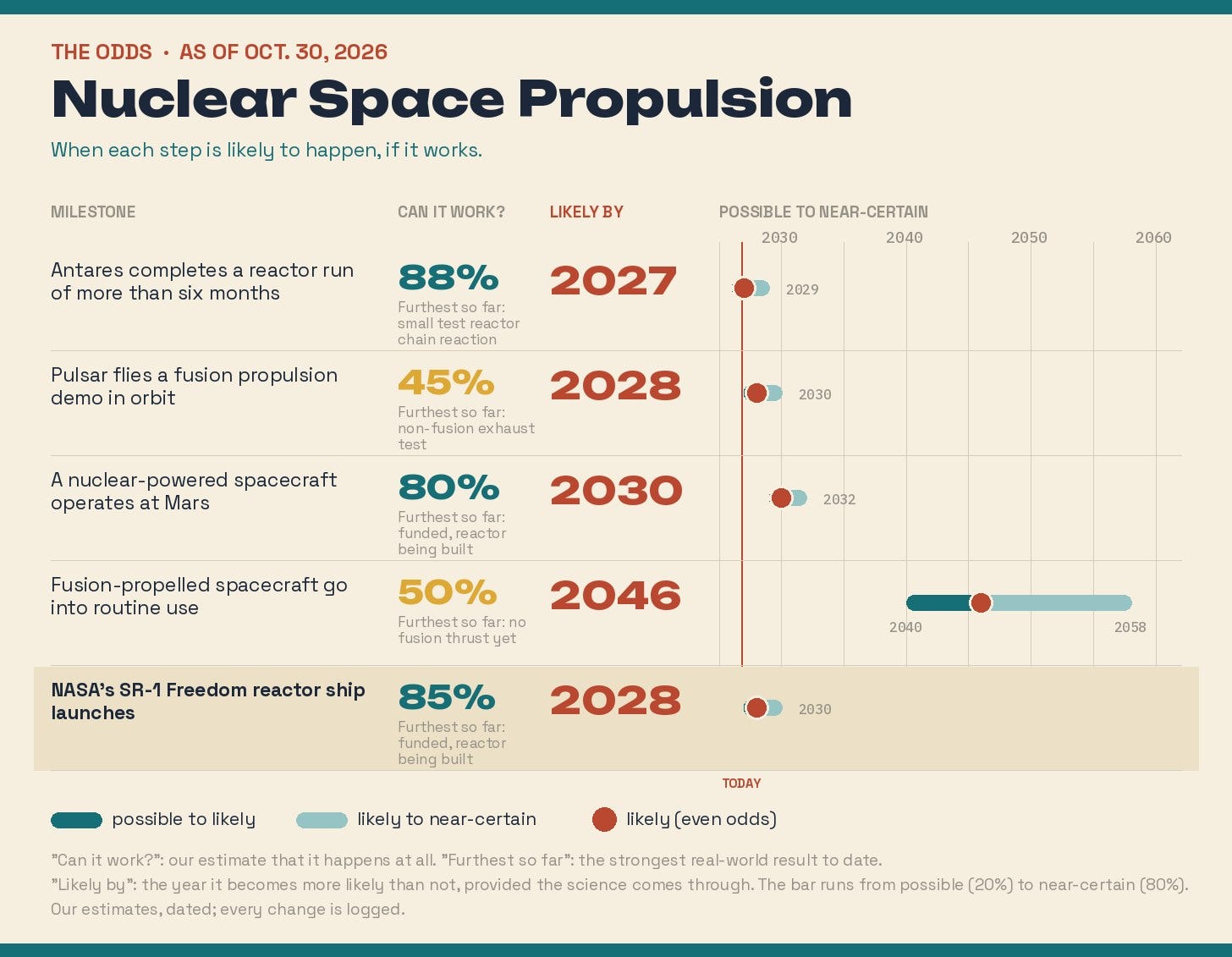
Note, Oct. 30, 2026: We overhauled how we present our odds to make them clearer. Every number we previously published still stands; the chart adds when each step is likely and how much faster it could come with digital patients.
Why these odds
These are our estimates, dated Oct. 25, 2026. They move only on new reporting, and every move is logged.
Antares completes a reactor run of more than six months by 2027: 45%. The Space Force has funded a Mark-1 run of more than six months in 2027 and the smaller Mark-0 already reached a chain reaction, but a run that long inside one calendar year leaves little slack.
Pulsar flies a fusion propulsion demo in orbit by 2027: 10%. Pulsar's only reported milestone is a brief exhaust test that was not fusion and produced no reported thrust.
SR-1 Freedom launches by 2028: 35%. The reactor is funded and being built for a December 2028 launch, but outside experts call the schedule aggressive and no readout is scheduled before launch.
A nuclear-powered spacecraft operates at Mars by 2030: 40%. One reasonable estimate puts this around 2030, with a range of 2029 to 2033; the only U.S. reactor ever flown died after 43 days, and the launch date has little room to slip.
Fusion-propelled spacecraft go into routine use by 2050: 30%. One projection puts this around 2050, with a wide range of 2040 to 2070 at low confidence; no device has produced fusion thrust, and Princeton estimates 10 to 20 years just to a working system.