


FREE READ. This one is on the house: the full story, the Odds board and the speculation, open to everyone. Most posts are free through the TL;DR only.
TL;DR
Walking, two-armed robots are no longer one-off lab demos. Somewhere between 19,100 and 25,000 humanoids shipped worldwide in the first half of 2026, and almost all of them were built in China. In the U.S., one model already moves totes in Amazon and Toyota sites and its successor is built to work beside people without a fence. Most still go to labs and schools, and a U.S. rule now keeps new Chinese models out. But the factories exist, and one maker says it is teaching its robots to upgrade themselves. The first coworker with legs is probably a warehouse robot; the one that folds laundry at home is further off.
Where it stands
China owns the volume. In one data set, about 19,100 humanoids shipped worldwide in the first half of 2026, and about 97% came from China: AgiBot made about 8,400 and Unitree about 5,900. The analyst firm IDC counts more, about 25,000 in the half year, up from 18,500 in all of 2025, with Chinese makers building roughly 95%. AgiBot passed 15,000 robots built in June, and Unitree plans capacity of 30,000 a year, 36Kr reported.
The buyers are the weak spot. More than 70% of Unitree's humanoid revenue came from research and education buyers and just 9% from industry. 36Kr also flags Ubtech's high output alongside a falling delivery rank, a sign of unsold robots. Tesla has given no Optimus unit target, and its V3 reveal has slipped repeatedly.
The newest claim is about how robots get better. Unitree is developing "Unitree Rehearsal," an AI system meant to let its humanoids improve themselves with little human engineering, TechRadar reported on Oct. 24, relaying the South China Morning Post. "In the past, every robotics engineer had to write code and debug manually," founder Wang Xingxing said. He suggested Unitree robots could be cleaning rooms as early as next year, and a Bloomberg headline dated Oct. 23 says he now expects a robotics breakthrough as soon as 2028. No demonstration was reported. All of it is company claim.
The U.S. is building for a different market: warehouses and factories. Agility Robotics' Digit 4 has logged more than 65,000 hours at sites including Amazon, GXO and Toyota, and Agility reports about $300 million in booked revenue across roughly 1,000 robots. Those orders are multi-year and subject to contractual milestones.
How we got here
July 5, 2026: As Agility prepared to go public, its CEO put home humanoids "10-plus years" away.
July 2026: At China's World Artificial Intelligence Conference, an official said Chinese humanoid output should top 100,000 units in 2026, about five times 2025's roughly 20,000.
July 20, 2026: Agility opened a 60,000-square-foot software site in Fremont, Calif., beside its Salem, Ore., factory.
July 28, 2026: The Federal Communications Commission added "foreign-produced advanced robotic devices" to its Covered List of national-security risks. New foreign-made models can no longer get the authorization needed to be imported or sold in the U.S. Models already authorized stay on sale, and makers can seek conditional approval after a security review and a pledge to move production to the U.S.
August 19, 2026: Unitree priced its IPO at about $9 billion and opened 629% higher in Shanghai, more than seven times its offering price, pushing its market value past 400 billion yuan.
September 15, 2026: Agility unveiled Digit 5. It lifts up to 50 lb repeatedly, about 40% more than Digit 4, and runs 90 minutes on a nine-minute charge: 10 minutes of work for every minute charging, up from 2. Agility says that allows about 20 hours of work a day, a vendor spec. Sensors let it steer around people or stop, so it needs fewer fences.
October 21, 2026: Tractor maker AGCO signed Agility to pilot Digit at its Hesston, Kan., plant in 2027, sorting parts and placing totes. No robot count or price was given.
October 23, 2026: IDC estimated the FCC rule leaves U.S. humanoid revenue 58% below its earlier forecast by 2030, more than $6 billion lost, with annual growth of about 9% instead of 13%. Household cleaning robots would shrink 18%. U.S. builders feel it too, since they depend on foreign motors and batteries.
What's next
Fourth quarter of 2026: Agility's merger with a blank-check company (a listed shell formed to buy a private firm), Churchill Capital Corp XI, at a $2.5 billion pre-money valuation, is expected to close.
First half of 2027: Digit 5 early access, with general availability by the end of 2027, and the AGCO pilot in Kansas.
2027, per Unitree's founder: room-cleaning Unitree robots. No date or demonstration has been given.
Jan. 1, 2029: the earliest end of the window in which already-authorized foreign robots can still get some software updates.
The odds (as of Oct. 25, 2026): Humanoid robots become routine in U.S. warehouses by 2028: 60%. Our estimate: Digit already does real warehouse work with about 1,000 robots booked; what remains is scale-up and cost.
The Odds
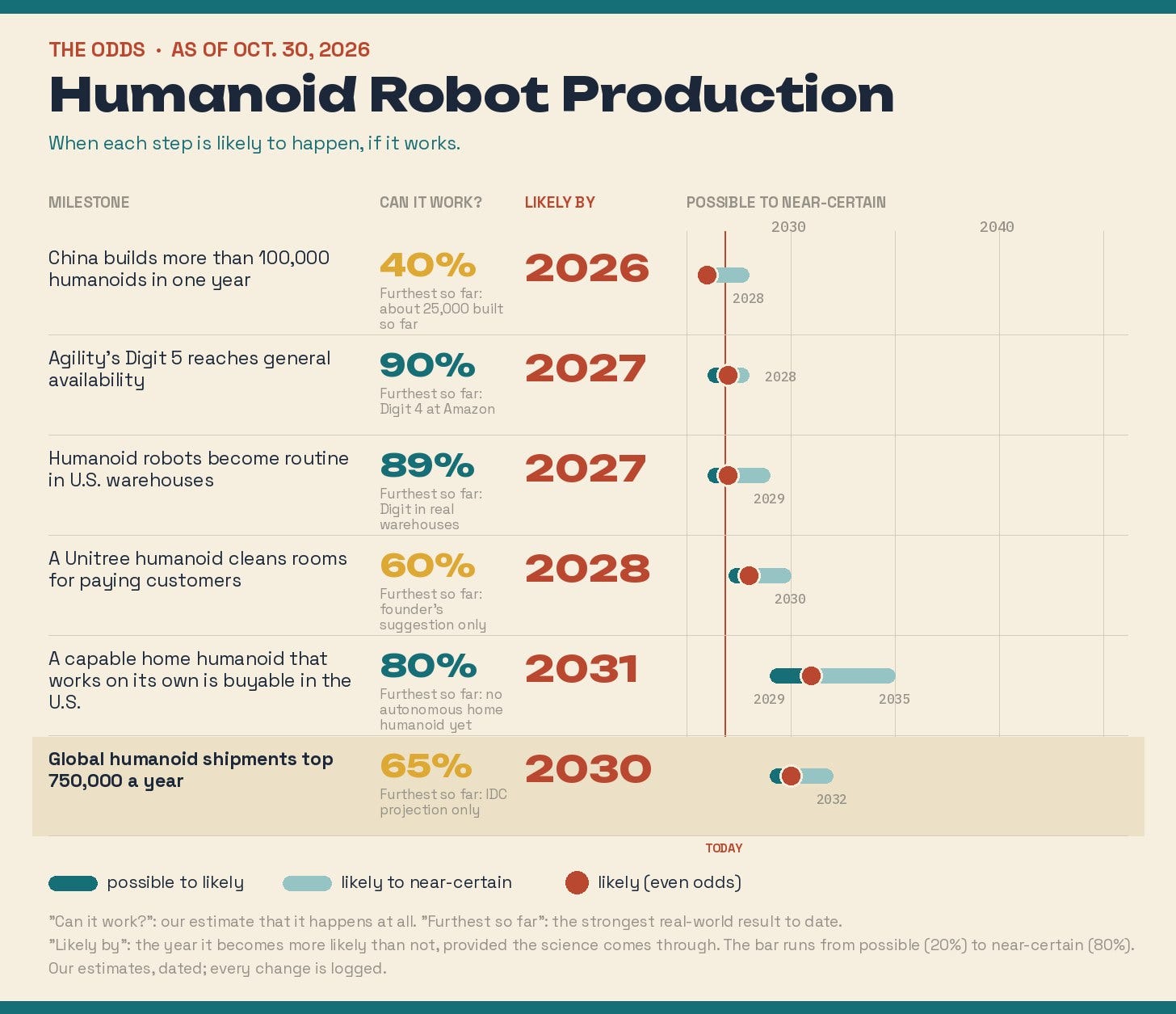
Note, Oct. 30, 2026: We overhauled how we present our odds to make them clearer. Every number we previously published still stands; the chart adds when each step is likely and how much faster it could come with digital patients.
Why these odds
These are our estimates, dated Oct. 25, 2026. They move only on new reporting, and every move is logged.
Agility's Digit 5 reaches general availability by 2027: 65%. Agility has set general availability for the end of 2027 and already runs Digit 4 at Amazon, GXO and Toyota; product dates slip, and the company is mid-merger.
China builds more than 100,000 humanoids in a single year by 2026: 25%. The official target needs roughly 75,000 more robots in six months after a first half of about 25,000 worldwide, and unsold inventory is already showing at Ubtech.
A Unitree humanoid is cleaning rooms for paying customers by 2027: 15%. Only the founder's suggestion supports this; Unitree has shown no demonstration of its self-improvement system, and no humanoid yet does chores on its own.
Humanoid robots become routine in U.S. warehouses by 2028: 60%. One reasonable estimate puts this around 2028, with a range of 2027 to 2030; Digit already works in real warehouses with about 1,000 robots booked, but those orders hinge on contractual milestones.
Global humanoid shipments top 750,000 a year by 2030: 35%. That is IDC's own projection, a roughly 15-fold jump from 2026's pace, and most buyers today are labs and schools rather than factories.
A capable humanoid home robot that works on its own is buyable in the U.S. by 2033: 45%. One reasonable estimate puts this around 2033, with a range of 2028 to 2038; the FCC rule blocks new cheap imports and reliable autonomy in messy homes is unsolved, and Agility's CEO says 10-plus years.
Putting it together (speculation)
Two developments from this summer fit together. In July, Google DeepMind's Gemini Robotics 2 showed one model controlling a whole humanoid body, planning jobs of several minutes and learning a new robot body from fewer than 200 demonstrations. In September, Digit 5 arrived with sensors and an independent controller built to let a humanoid work near people.
Today's warehouse humanoids mostly repeat one job, such as moving totes, in fenced areas. Our speculation: a general planning brain on a body designed to share space with people could let one robot switch among several tasks on a shift without being reprogrammed, which could pull multi-task humanoid coworkers into 2027 to 2028. Both pieces are scheduled for 2027 at the earliest, DeepMind's full-body model is limited to early partners, and nothing links the two companies. It is an inference, not an announced plan.
Unitree's plan adds a third piece: if robots can test their own improvements overnight, progress could follow software-update curves instead of multi-year hardware cycles. Unitree has shown nothing yet.