



FREE READ. This one is on the house: the full story, the Odds board and the speculation, open to everyone. Most posts are free through the TL;DR only.
TL;DR
Hearing medicine is crossing a line it never crossed before: from protecting what is left to putting hearing back. Since April an approved gene therapy has given children born with one form of deafness real hearing: 4 in 5 in its main study reached levels that usually avoid a cochlear implant. A pill has now shown, in a company analysis, that about one in three patients with an inner-ear disorder gained back a meaningful slice of hearing, against about one in nine on a dummy pill. And a cochlear implant with nothing worn outside the head is closing in on an FDA filing. Each of these is narrow, but together they point to a future where hearing loss is treated, not just amplified.
Where it stands
Gene therapy for genetic deafness
In April the FDA approved Regeneron's Otarmeni, the first gene therapy for genetic deafness. In its evidence, 16 of 20 children, 4 in 5, reached hearing levels that usually avoid a cochlear implant. In October the New England Journal of Medicine published results from the CHORD trial of the OTOF gene therapy, a one-time inner-ear treatment, Cincinnati Children's said. Of the first 12 children, 9 could hear sounds at 70 decibels or quieter by 24 weeks, 4 reached normal or near-normal hearing, and 1 did not respond, for reasons not given. The therapy covers only one rare genetic form, about 1% of congenital deafness, so the next milestone is gene therapy for the more common deafness genes.
A pill that may restore hearing
Sound Pharmaceuticals of Seattle enrolled 221 adults with Ménière's disease, an inner-ear disorder that brings episodes of vertigo and fluctuating hearing loss, in STOPMD-3, its Phase 3 trial of SPI-1005, an oral anti-inflammatory pill containing ebselen. Of the 191 analyzed, 95 on 400 mg twice daily and 96 on placebo, about one in three on the drug gained at least 10 decibels across three speech frequencies after 84 days, against about one in nine on placebo (32.6% vs. 11.5%). Measured across four frequencies, the gap was wider: about one in three against one in eleven (33.7% vs. 9.3%). On a test of picking out words in background noise, 42.1% got at least four more words right, against 27.1%. Some patients kept improving for 12 months in an open-label extension, which had no placebo group.
These are company figures from a post-hoc analysis, one done after the fact, of patients who followed the protocol, not the trial's prespecified result. Thirty of the 221 people enrolled are missing from these numbers, and a look limited to patients who stayed on plan can flatter a drug. The pill holds FDA Breakthrough Therapy Designation for Ménière's-related hearing loss, which speeds review but is not an approval. A separate open-label Phase 3 safety study finished enrolling in July, and no filing date has been announced. The company says the data could support testing the pill in sudden sensorineural hearing loss, the abrupt hearing drop that today has only steroids, but nothing yet shows it works there.
A pill to protect hearing
China cleared Ting Therapeutics' oral TT004 for a Phase Ib safety study in Shanghai in head-and-neck cancer patients receiving cisplatin, a chemotherapy drug that can damage hearing and kidneys. The company says it cut hearing and kidney damage about 70% in animals; there are no human efficacy data yet (Hearing Health Matters).
A fully implanted cochlear implant
A cochlear implant bypasses damaged parts of the inner ear and stimulates the hearing nerve directly; most have an external processor. Envoy Medical's Acclaim is fully implanted, with nothing outside. All 56 adults in its pivotal trial, the large trial that supports an approval decision, are past three-month follow-up. No results have been released, so whether a fully implanted device hears as well as a conventional one is unknown.
How we got here
April 2026: The FDA approved Otarmeni, the first gene therapy for genetic deafness.
July 2026: SPI-1005's separate open-label Phase 3 safety study finished enrolling.
October 8, 2026: NEJM published the CHORD results.
October 19, 2026: Sound Pharmaceuticals reported its post-hoc Phase 3 analysis, and Envoy's 56 trial patients all passed three-month follow-up.
October 25, 2026: TT004 was reported cleared for its first human study in China.
What's next
By April 2027: Envoy Acclaim's 12-month trial visits finish, followed by an FDA filing.
No date given: An FDA filing date for SPI-1005, and any prespecified result confirming the post-hoc benefit.
No date given: Human safety results from TT004.
No date given: Gene therapies for deafness genes more common than OTOF.
The odds (as of Oct. 25, 2026): The FDA approves a pill that restores hearing in Ménière's disease by 2029: 35%. Our estimate: the effect size is striking, but it has to survive a cleaner analysis before a regulator will bite.
The Odds
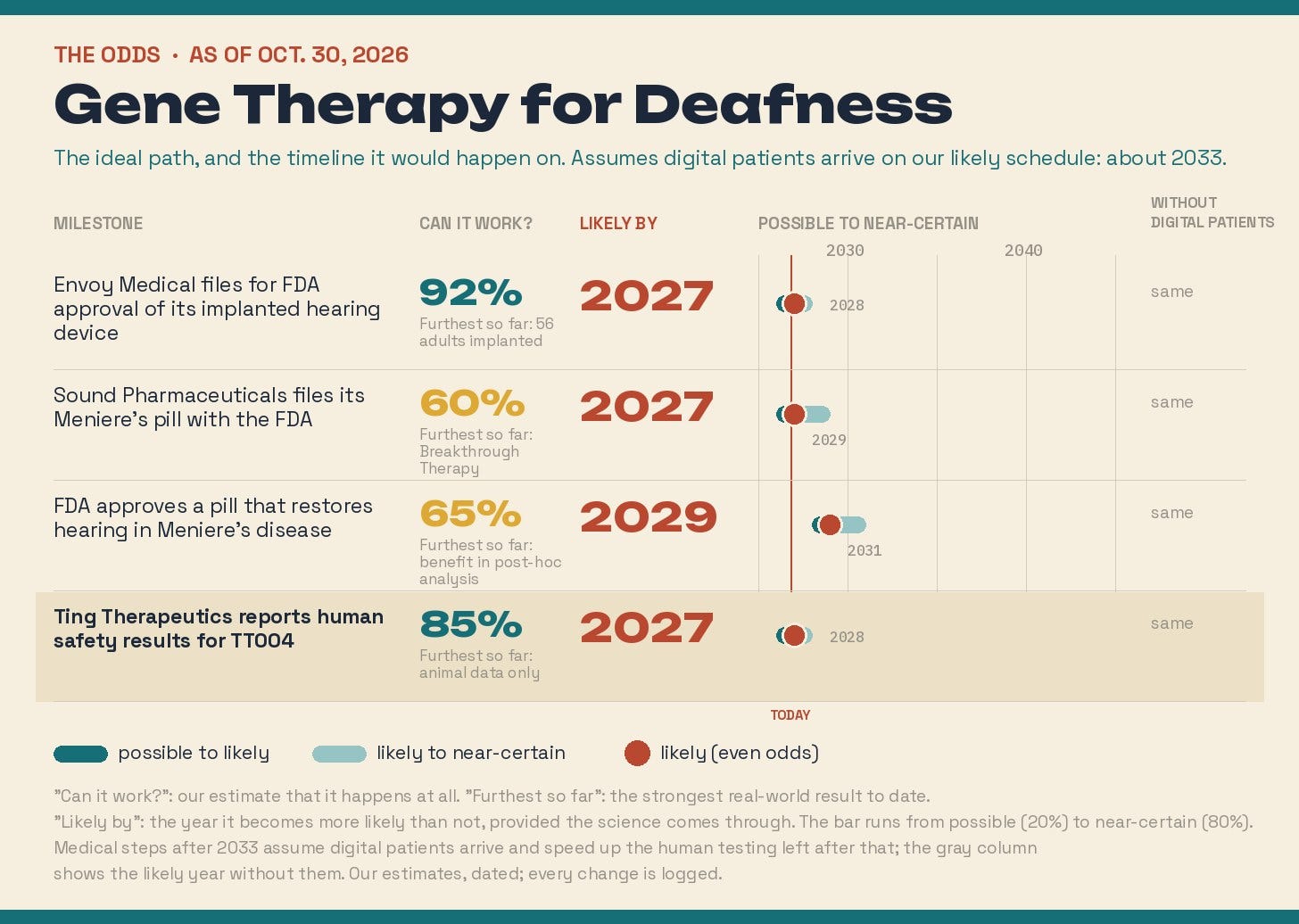
Note, Oct. 30, 2026: We overhauled how we present our odds to make them clearer. Every number we previously published still stands; the chart adds when each step is likely and how much faster it could come with digital patients.
Why these odds
These are our estimates, dated Oct. 25, 2026. They move only on new reporting, and every move is logged.
Envoy Medical files for FDA approval of the fully implanted Acclaim by 2027: 70%. All 56 adults are past three months and 12-month visits finish by April 2027, with a filing planned after; no results have been released.
Sound Pharmaceuticals files SPI-1005 with the FDA for Ménière's hearing loss by 2027: 30%. The drug has Breakthrough Therapy Designation, but the benefit so far shows only in an after-the-fact company analysis and no filing date has been announced.
Ting Therapeutics reports human safety results for TT004 by 2027: 50%. China cleared the Phase Ib study in October; the company has given no timeline and has animal data only.
The FDA approves a pill that restores hearing in Ménière's disease by 2029: 35%. One reasonable estimate puts this around 2029, with a range of 2028 to 2032; the Phase 3 gap is large, but it rests on a post-hoc analysis that leaves out 30 of 221 patients.