



FREE READ. This one is on the house: the full story, the Odds board and the speculation, open to everyone. Most posts are free through the TL;DR only.
TL;DR
For the first time, a therapy built to turn old cells younger has been put into people, and it did no harm. Three glaucoma patients got a one-time eye injection; none had a serious side effect, and two of the three saw better on a standard vision test. That is a tiny, uncontrolled safety study, and it says nothing yet about reversing aging across a whole body. What it does is move age reversal out of mouse papers and into the clinic, one organ at a time. If the higher dose holds up, the first practical payoff could be restored sight in an eye disease that today can only be slowed, and every later attempt at rejuvenating other tissues will be measured against it.
Where it stands
Every cell carries the same DNA. What makes a cell old, or a nerve cell rather than a skin cell, is partly the pattern of chemical tags on that DNA (the epigenome) that switch genes on and off. Reprogramming uses a few master genes to reset that pattern. The best known are the "Yamanaka" genes; three of them, OCT4, SOX2 and KLF4, together called OSK, can push aged cells back toward a younger state. The catch is identity: the further a cell's clock is turned back, the likelier it is to forget its job. "Partial" reprogramming tries to stop short of that point.
Life Biosciences' ER-100 is the first partial-reprogramming therapy given to people. It is a one-time eye injection carrying the three OSK genes, switched on by a daily doxycycline pill for eight weeks, meant to reset worn-out optic-nerve cells. It leaves out c-Myc, the fourth Yamanaka factor, which is linked to cancer. On Oct. 8 the company released the first human data: 3 adults with open-angle glaucoma got the lowest dose, and all 3 got through day 56 with no serious side effects and no dose-limiting toxicity. An independent safety board cleared a dose three times higher. Two of the three, about 67%, improved on a standard vision test: in each, at least 28% of the tested spots, a bit more than one in four, got more than 4 decibels more sensitive, Eyewire reported (a decibel here is a step on the test's light-sensitivity scale). The third did not improve.
The company states the limits itself. The study is open-label, has no control group and three patients, has no peer-reviewed paper yet, and was built to test safety, so Life Biosciences calls the vision results preliminary. Vision-field tests are also noisy, because people improve with practice. Chief scientist Sharon Rosenzweig-Lipson said the team is "encouraged" by the go-ahead to escalate.
How we got here
October 8, 2026: Life Biosciences released the ER-100 results, the first human data from any partial-reprogramming therapy.
October 14, 2026: George Church's lab at Harvard reported in Nature Aging that a gene called SRSF1, which controls how other genes' messages are spliced, made old human skin cells from donors aged 55, 65 and 79 act younger without switching on stem-cell genes. It cut senescence and inflammation signals and restored DNA-repair programs; senescence-linked enzyme activity fell about 70% across five donor lines. In old mice, a liver-targeted version raised median survival from 778 days to 886, about 108 extra days or 14%, in just 10 treated and 9 control mice, all female. Only one of several aging clocks read the livers as younger, and wound and muscle repair did not improve.
October 21, 2026: A team led by Oliver Brüstle at University Hospital Bonn, the University of Bonn and RWTH Aachen took red-blood-cell precursors from an 80-year-old donor and converted them directly into neural stem cells. Epigenetic clocks read the new cells as under 20, about 60 years younger than the donor, a drop that built gradually over more than 100 days in a dish. Brüstle calls the slow pace "ideal as an experimental model." The authors claim no human treatment.
What's next
No date given: Results from ER-100's higher-dose group, three times the first dose. The company has set no date; one reasonable estimate is 2027.
No date given: More cohorts listed in the trial record, including another optic-nerve disease. Patients are to be followed to about 2032, so the long-term safety answer will take years.
November 4 to 7, 2026: The Gerontological Society of America meeting in National Harbor, Md., the next dated event on the aging beat.
The odds (as of Oct. 25, 2026): A reprogramming gene therapy for glaucoma vision loss is available by 2034: 40%. Our estimate: human safety is shown and a higher dose is cleared, but efficacy is unproven and one company carries the field.
The Odds
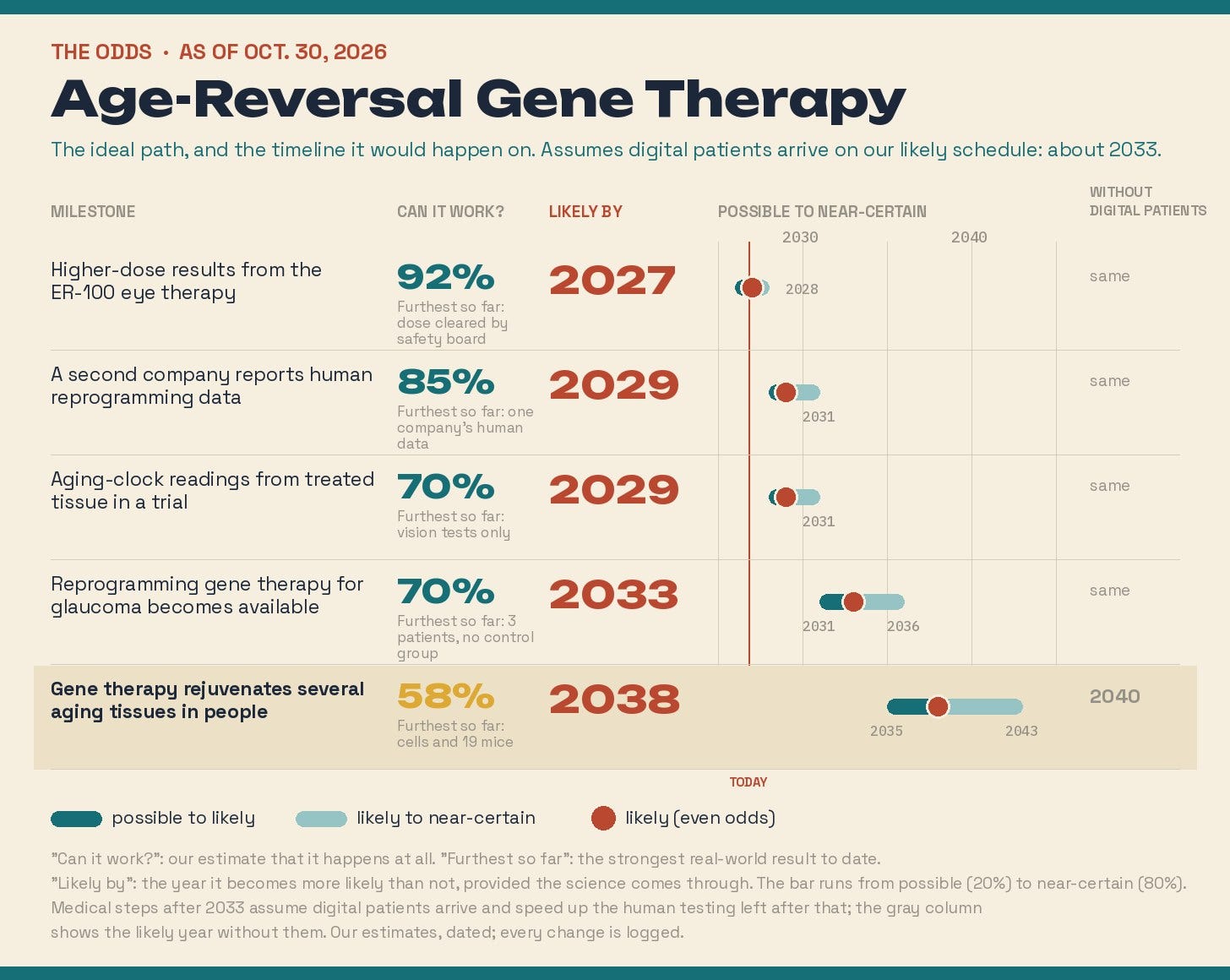
Note, Oct. 30, 2026: We overhauled how we present our odds to make them clearer. Every number we previously published still stands; the chart adds when each step is likely and how much faster it could come with digital patients.
Why these odds
These are our estimates, dated Oct. 25, 2026. They move only on new reporting, and every move is logged.
ER-100 higher-dose results made public by 2027: 60%. The safety board has already cleared the dose and one reasonable estimate puts results in 2027, but the company has given no date.
A second company reports human data from a reprogramming therapy by 2028: 25%. ER-100 is still the only human reprogramming data, and no other company in the field has announced a dated human readout.
A reprogramming trial reports aging-clock readings from treated tissue by 2028: 20%. ER-100's results so far are vision tests, not clock readings, and no trial has said it will add them.
A reprogramming gene therapy for glaucoma vision loss is available by 2034: 40%. One projection puts it around 2034, with a range of 2031 to 2040; two of three patients improved, but in an open-label safety study with no control group.
A gene therapy that rejuvenates several aging tissues in people by 2045: 35%. One projection puts it around 2045, with a range of 2038 to 2055 at low confidence; the best multi-tissue evidence is cells and 19 mice, with one aging clock agreeing and no repair gains.
Putting it together (speculation)
Three recent facts line up. ER-100 became the first reprogramming therapy with human safety data. FDA officials asked for a shared aging endpoint, a common measure trials could use to show a drug slows aging. And an August analysis of 51 trials found that epigenetic clocks trained to predict death respond most reliably to treatments.
Speculation: if reprogramming trials add clock readings from the treated tissue, those readings could become the first real test of such an endpoint, and a clock that moves alongside a functional gain like better vision would be far more persuasive to a regulator than either alone. The strongest doubt comes from Fight Aging!'s Reason, who says aging clocks "cannot be trusted to provide useful results for any given novel intervention." ER-100's published results so far report vision tests, not clock readings.