



FREE READ. This one is on the house: the full story, the Odds board and the speculation, open to everyone. Most posts are free through the TL;DR only.
TL;DR
China says it has run a floating train through a tube with most of the air pumped out at 387 miles an hour, faster than any maglev has officially gone. If the claim holds and the idea scales, it points to ground travel that could rival flying: a train with no wheels touching anything and almost no air in its way, designed to reach about 621 mph. That is roughly twice the speed of the nearest real high-speed maglev line, in Japan. But the run happened in a test tube about a mile and a quarter long, the number comes from the state contractor that built it, and the long track that would test the real design speed has no date. For now this is a record claim and a blueprint, not a route anyone can ride.
Where it stands
A vacuum-tube maglev combines two ideas. Maglev, short for magnetic levitation, lifts a train off its guideway with magnets, removing wheel friction. Putting the train inside a low-vacuum tube, one with most of the air pumped out, also cuts air resistance, the main drag at very high speed. Remove both, and the remaining limits are engineering ones: how fast the magnets can push, and how well the tube can hold its vacuum.
On June 27, China Aerospace Science and Industry Corp. (CASIC), a state contractor, reported a levitated run at 623 kilometers per hour, about 387 mph, inside a 2-kilometer low-vacuum tube, about 1.2 miles long. That is a company claim, and it has not been independently confirmed. Japan's crewed run at 603 km/h, about 375 mph, from 2015 remains the official maglev speed record, so CASIC's figure would beat it by about 20 km/h, roughly 12 mph, if confirmed.
Nothing newer has been reported. A search for maglev and vacuum-tube tests found no news dated Oct. 15 to 25, and CASIC's June run is still the most advanced high-speed ground result reported.
How we got here
2015: Japan set the official maglev speed record, a crewed run at 603 km/h, about 375 mph.
June 27, 2026: CASIC reported its 623 km/h run inside a 2-kilometer low-vacuum tube.
Through October 25, 2026: No date was announced for CASIC's next step, and no independent confirmation of the June run was reported.
The nearest real comparison is Japan's Chuo maglev, the nearest real high-speed maglev line. It runs in open air at 311 mph and opens in 2036 or later. A tube maglev at CASIC's design speed would be about twice as fast.
The hard parts change with scale. A short tube proves the train can levitate and go fast. A long one has to hold a vacuum, and stay safe, over distances that matter for travel. That is why the next step matters more than the record.
CASIC's next step is a 60-kilometer track, about 37 miles, meant to reach the system's 1,000 km/h design speed, about 621 mph. The jump is large on both counts: the planned track is 30 times longer than the test tube, and the design speed is about 1.6 times the June run. At full design speed, a train would cover that whole 60-kilometer track in under four minutes. No date has been given for building it.
What's next
No date given: A date for CASIC's 60-kilometer track, the test of whether the system can reach 1,000 km/h.
No date given: Independent confirmation of CASIC's 623 km/h run.
2036 or later: Japan's open-air Chuo maglev is due to open, the benchmark any tube system will be compared against.
The odds (as of Oct. 25, 2026): A passenger ride on a 1,000 km/h vacuum-tube maglev by 2045: 35%. Our estimate: the test-tube speed is promising, but the long track that would prove the design speed has no date, and every figure so far comes from the builder.
The Odds
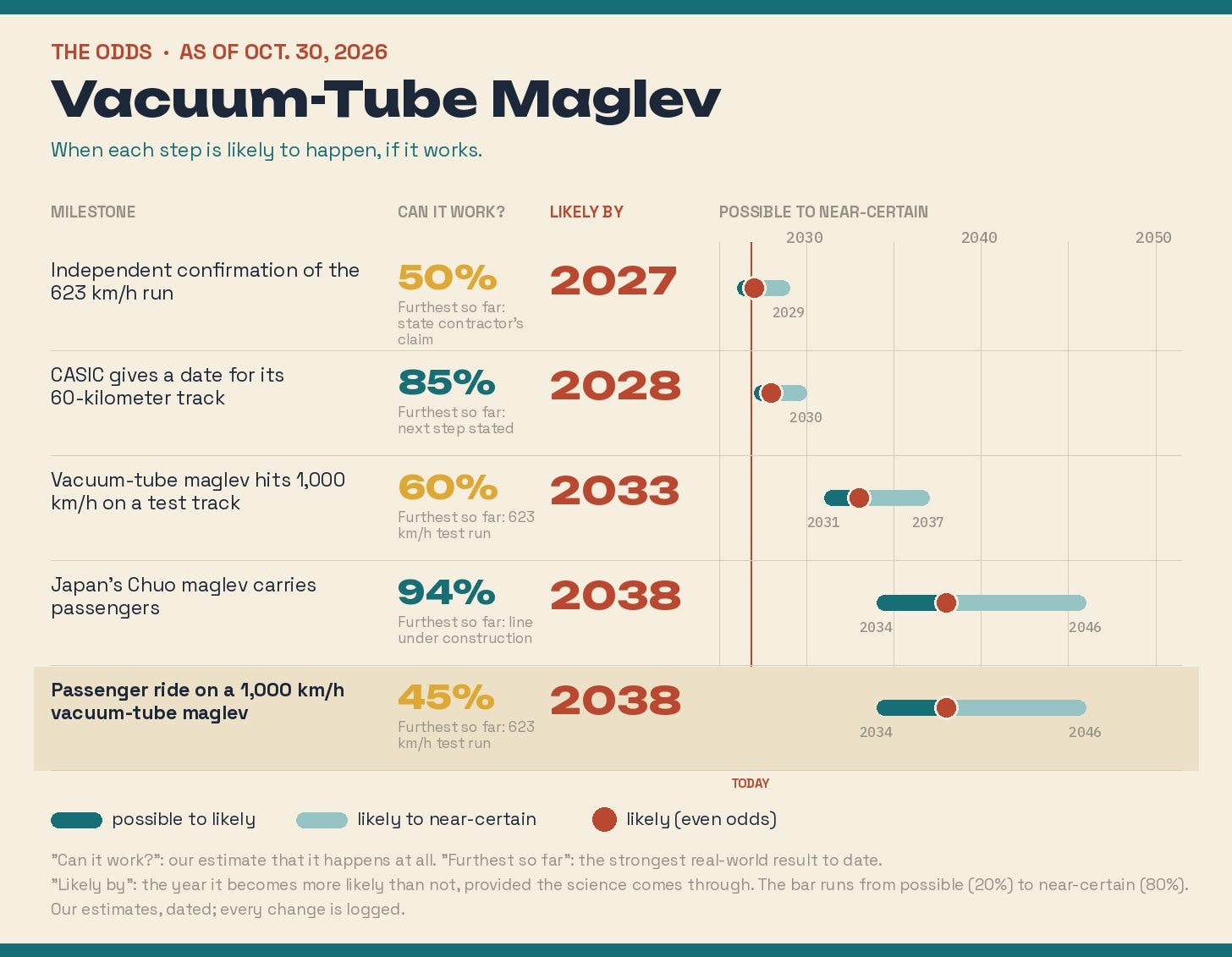
Note, Oct. 30, 2026: We overhauled how we present our odds to make them clearer. Every number we previously published still stands; the chart adds when each step is likely and how much faster it could come with digital patients.
Why these odds
These are our estimates, dated Oct. 25, 2026. They move only on new reporting, and every move is logged.
Independent confirmation of CASIC's 623 km/h run by 2027: 20%. The figure has stood as a state contractor's claim since June with no outside verification reported.
CASIC gives a date for its 60-kilometer track by 2028: 35%. It is the stated next step, but no date has been given and nothing new has been reported since June.
A vacuum-tube maglev reaches 1,000 km/h on a test track by 2032: 20%. That needs a track 30 times longer than today's test tube and a speed about 1.6 times the June run, on a line that has not been dated.
Japan's Chuo maglev carries passengers by 2038: 50%. One projection puts its opening at 2038; the line is due in 2036 or later, and nothing reported suggests it will open sooner.
A passenger ride on a 1,000 km/h vacuum-tube maglev by 2045: 35%. One projection puts it around 2045, with a range of 2038 to 2060 at low confidence; whether the tube becomes a ride or a permanent test track depends on the undated 60-kilometer line.