



FREE READ. This one is on the house: the full story, the Odds board and the speculation, open to everyone. Most posts are free through the TL;DR only.
TL;DR
People who lost the ability to move or speak are now typing, steering cursors and talking through chips in their brains. One woman with a motor neuron disease that had nearly silenced her now speaks her own sentences through a wireless implant, and the FDA has let trial users run such implants from their own phones and laptops. The science of reading the brain works. What is missing is the boring, decisive part: pivotal trials, approvals, insurance and hospitals able to place the devices without a research team. If that comes together, a take-home voice prosthesis for paralysis could arrive around the turn of the decade. Writing back to the brain is next, and the first chips for it are just leaving the lab.
Where it stands
A brain-computer interface records electrical activity from the brain and turns it, with software called a decoder, into an action: moving a cursor, picking letters, producing synthesized speech or driving a robotic glove. The United States has approved zero prescription brain implants. China approved one, Neuracle's wireless implant, in March; it drives a robotic glove for people with spinal cord injuries, and approval rested on 36 procedures whose full data are not yet public. An analyst estimate puts the first U.S. approval at 2028 to 2030.
The clearest human result is Paradromics'. Its first patient, a Michigan woman in her 60s with a progressive motor neuron disease, received the Connexus implant in June. It records single neurons through 421 fine wires and transmits wirelessly through the skin. On Sept. 14 the company said she had moved beyond preset sentences to her own words and spoke to her grandchildren. Her first freely chosen sentence, "Okay, I have a lot to say," was decoded with no errors, CBS Austin reported. That is one patient, company-reported, and RuntimeWire noted that no speed or accuracy figures across sessions have been published.
The others are moving too. Neuralink had 21 people enrolled as of Jan. 28, per Reuters, and says one participant set a cursor record of 11.32 bits per second, up from 10.39, as summarized by TeslaNorth (bits per second measures how much information a user sends each second, so the record is about 9% faster). Precision Neuroscience, whose thin film rests on the brain's surface and records from 4,096 electrodes, raised a $250 million Series D, bringing its total to $430 million. And a UCSF team showed in Nature Neuroscience that one array can decode speech and gestures together to drive an avatar: in real time, one participant's gestures were read correctly 66% of the time, about two in three, and speech 70%, News-Medical reported, with restricted vocabularies.
How we got here
June 17, 2026: University of Michigan surgeons implanted the first Connect-One participant. The trial aims to enroll up to 10 people and follow them for six years.
August 26, 2026: The FDA approved an expansion letting Connect-One users run the implant on their own laptops, tablets and phones.
September 14, 2026: Paradromics reported real-time speech in its first patient.
October 8, 2026: Paradromics said two sheep carrying similar electrodes recorded stably for more than four years, an unpublished company result.
October 15, 2026: Precision named Nevro founder Konstantinos Alataris president, a hire aimed at sales and insurance coverage.
October 19, 2026: Paradromics and Siemens Healthineers announced a plan for one imaging workflow, MRI and CT, to select patients, plan surgery and confirm placement in ordinary hospitals. InsideBCI notes no terms or dates, and that it is unclear whether it will work on other makers' scanners.
October 23, 2026: EPFL announced LogSync, a 4-by-2-millimeter chip that reads brain rhythms and decides when an implant should stimulate, using under 200 microwatts, about two ten-thousandths of a watt. It has run only on previously recorded human data and in rats, with no accuracy or delay figures.
What's next
No date given: Connect-One's first communication results, the first checkable numbers.
No date given: Terms and a timeline for the Paradromics and Siemens Healthineers workflow.
No date given: The start of Synchron's U.S. pivotal trial; its next-generation Stentrode, delivered through a blood vessel, entered a 10-patient Australian trial with up to 16 commands versus 2 before.
No date given: A first closed-loop human test of LogSync.
The odds (as of Oct. 25, 2026): A brain implant for computer control is approved for prescription in the U.S. by 2030: 50%. Our estimate: decoding works in people and an analyst puts the first approval at 2028 to 2030, but the U.S. count is still zero and no pivotal trial has reported.
The Odds
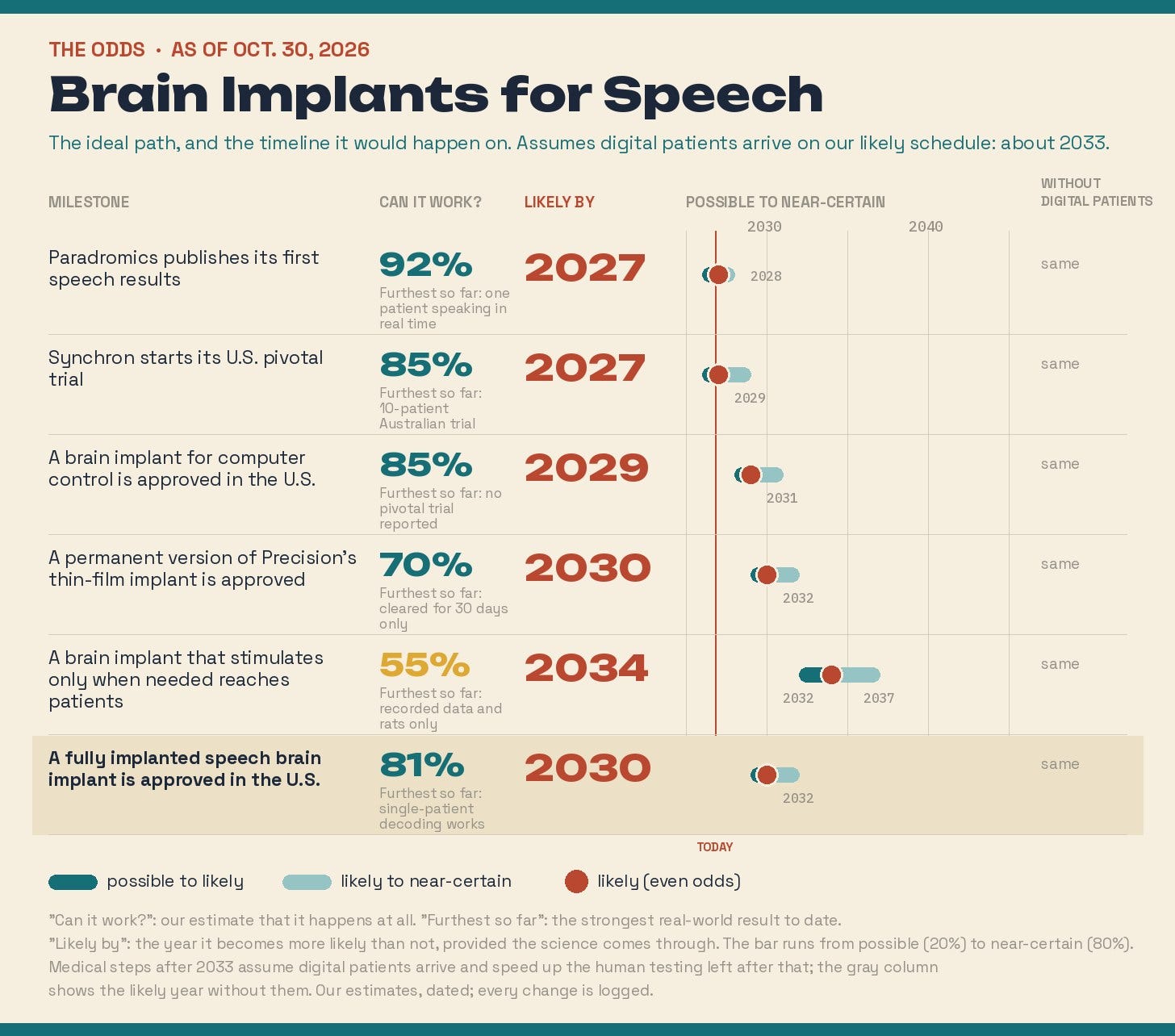
Note, Oct. 30, 2026: We overhauled how we present our odds to make them clearer. Every number we previously published still stands; the chart adds when each step is likely and how much faster it could come with digital patients.
Why these odds
These are our estimates, dated Oct. 25, 2026. They move only on new reporting, and every move is logged.
Paradromics publishes its first Connect-One speech results by 2027: 55%. One patient is already speaking in real time and the trial follows patients for six years, but the company has given no date and no speed or accuracy figures so far.
Synchron starts its U.S. pivotal trial by 2027: 35%. Its next-generation Stentrode went to a 10-patient Australian trial in April, but the U.S. pivotal trial still has no start date.
A brain implant for computer control is approved for prescription in the U.S. by 2030: 50%. One projection puts it around 2030, with a range of 2028 to 2034, matching an analyst estimate of 2028 to 2030; the U.S. count today is zero and no pivotal trial has reported.
A permanent version of Precision's thin-film implant is approved by 2030: 40%. The film is cleared for 30 days and has 100-plus procedures and $430 million behind it, but a permanent version needs full premarket approval and long-term safety data.
A fully implanted speech-restoring brain implant is approved in the U.S. by 2031: 50%. One projection puts it around 2031, with a range of 2028 to 2035; decoding works in single patients and sensors lasted four years in sheep, but a pivotal trial has not started.
A brain implant that stimulates only when the brain's state calls for it reaches patients by 2036: 35%. One projection puts it around 2036 at low confidence, with a range of 2032 to 2045; EPFL's chip has run only on recorded data and in rats.
Putting it together (speculation)
Between late August and early October, Paradromics stacked three pieces: trial users may pair the implant with their own phones and laptops, the first patient spoke in real time, and sheep implants recorded steadily for more than four years. Speculation: together they describe a fully implanted, wireless voice prosthesis that pairs with a person's own phone and keeps working for years without another operation. Each piece exists today on its own; none has been shown together in many patients. One projection puts speech implants running all day from users' own phones around 2032, at low confidence. If Connect-One adds participants and publishes error rates, the next step would be a pivotal trial for a take-home speech implant rather than a lab system.
Speculation: the writing side now has a new part. A chip that classifies brain states and fires stimulation on a fraction of a milliwatt is the kind of component a future memory prosthetic would need. No one has shown that pairing in a person, and no human test date has been given.