


FREE READ. This one is on the house: the full story, the Odds board and the speculation, open to everyone. Most posts are free through the TL;DR only.
TL;DR
A whole kidney has been frozen into a glass-like state for more than a year, warmed back up and made urine. University of Minnesota researchers did it with pig kidneys, which are about the size of human ones, using magnetic nanoparticles to rewarm them evenly. Today a donor kidney lasts 24 to 36 hours outside the body, so a kidney that can wait a year would change transplant medicine from a race against the clock into something closer to a pharmacy shelf: organs banked, matched carefully and shipped when needed. That future is still a long way off. The rewarmed kidneys were damaged by the antifreeze, transplanted ones were watched for only two hours, and the work has not been peer reviewed. And none of it brings whole-body cryosleep any closer: no person has ever been revived.
Where it stands
A team led by transplant surgeon Erik Finger and bioengineer John Bischof cooled whole pig kidneys into a glass-like state, a process called vitrification, at about -238 °F (-150 °C), and banked them, most for days or weeks and one for just over a year, MIT Technology Review reported. The team rewarmed the kidneys with iron-oxide nanoparticles in an electromagnetic field, so the whole kidney heats evenly from within.
The kidneys regained color and made urine at about two-thirds of the expected amount. The year-old one made urine right away on a perfusion machine, which pumps fluid through an organ outside the body. Some were transplanted into pigs and watched for just two hours.
The scale is the news. A pig kidney is about 100 times the size of the rat kidneys this team revived in 2023. The limits are just as plain. The kidneys showed injury the team blames on the antifreeze chemicals. The work is a bioRxiv preprint, not yet peer reviewed. And cryobiologist Greg Fahy said, "We can't tell from these experiments whether these kidneys might have supported life or not."
How we got here
2023: The same Minnesota team revived vitrified rat kidneys.
January 2025: Tim Andrews received a gene-edited pig kidney that kept him off dialysis for 271 days, about nine months, before he received a human kidney, the first patient to bridge from one to the other. The Lancet published his case on Sept. 3, 2026.
April 28, 2026: The CEO of Alcor, which offers whole-body preservation for about $220,000, said, "I don't know if this will ever work." No one has been revived, and a 2026 review says humans cannot yet enter even medical torpor, the slowed-down state some animals use to survive.
October 7, 2026: The Minnesota preprint was posted.
October 15, 2026: MIT Technology Review reported the year-frozen kidney.
October 20, 2026: United Therapeutics opened its third sealed facility for raising gene-edited pigs for their organs, in Houston, to supply kidneys and hearts. It gave no capacity.
Those last two lines are why organ banking matters now. Gene-edited pig organs are becoming a working bridge to transplant, and the farms to supply them are being built. Every source of organs, human donors and pigs alike, runs into the same 24-to-36-hour clock. Banking is the missing logistics layer under all of them.
What's next
No date given: Longer pig transplants of rewarmed kidneys, to show whether a banked organ can keep an animal alive.
No date given: Gentler antifreeze chemicals to reduce the injury.
No date given: Tests on human kidneys, which the team names as the step after that.
No date given: Peer-reviewed publication of the preprint.
Whole-body suspended animation does not move with this result. A kidney is one organ with one job, rewarmed on a machine; a body is many organs and a brain that must all come back at once.
The odds (as of Oct. 25, 2026): A banked, rewarmed kidney is transplanted into a person by 2036: 40%. Our estimate: human-sized kidneys now survive a year in the bank, but nobody has shown one can keep a living animal alive.
The Odds
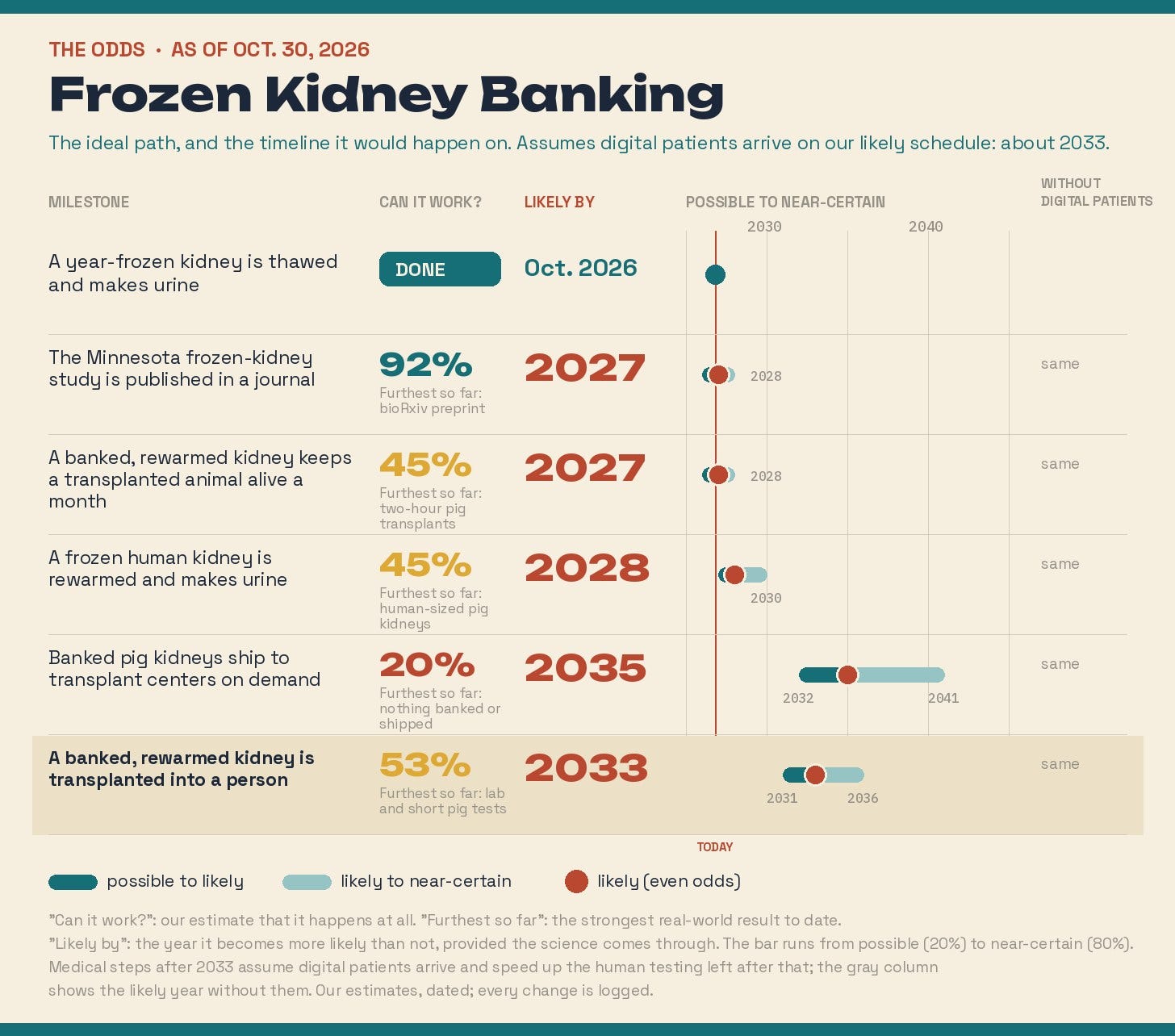
Note, Oct. 30, 2026: We overhauled how we present our odds to make them clearer. Every number we previously published still stands; the chart adds when each step is likely and how much faster it could come with digital patients.
Why these odds
These are our estimates, dated Oct. 25, 2026. They move only on new reporting, and every move is logged.
The Minnesota kidney study is published in a peer-reviewed journal by 2027: 70%. It is a bioRxiv preprint posted Oct. 7, and the team has named next steps that build on it.
A banked, rewarmed kidney keeps a transplanted animal alive for a month by 2028: 35%. Transplanted kidneys were watched for only two hours, and cryobiologist Greg Fahy says the experiments cannot show whether they would have supported life.
A vitrified human kidney is rewarmed and makes urine by 2029: 30%. The team names human kidneys as a later step, after longer pig transplants and gentler antifreeze; the antifreeze injury is still unsolved.
A banked, rewarmed kidney is transplanted into a person by 2036: 40%. One projection puts this around 2036, with a range of 2032 to 2042; human-sized kidneys now rewarm and make urine, but survival in a living animal is unshown and human trials have not begun.
Banked pig kidneys ship to transplant centers on demand by 2040: 15%. One speculative projection puts this around 2040 at low confidence; it needs both gene-edited pig kidneys to become routine and banking to work, and neither has happened.