



FREE READ. This one is on the house: the full story, the Odds board and the speculation, open to everyone. Most posts are free through the TL;DR only.
TL;DR
Tardigrades, the microscopic "water bears" that survive almost anything, carry a protein that wraps around DNA like armor. Put into human cells, it cut radiation damage to DNA by about 40%. Delivered to mice as genetic instructions, it cut DNA breaks by about half. That is the raw material for a drug that could protect healthy tissue during cancer radiation, or protect astronauts on a nine-month trip to Mars. It is also where the story stops for now: the protein harmed mouse brain cells, nobody fully agrees how it works, and no one has tried it in a person. The U.S. military once funded a different way to make people radiation-resistant, and seven years later has published nothing. Human radiation-proofing is real science, but it is still in the animal stage.
Where it stands
Tardigrades are microscopic animals famous for surviving extreme conditions. One of their proteins, Dsup, wraps itself around DNA and prevents damage rather than repairing it after the fact.
Two results anchor the field. In 2016, engineered human cells carrying Dsup showed about 40% less DNA fragmentation after X-rays: for every 10 breaks in normal cells, about 6 in protected ones. In 2025, an MIT team under Giovanni Traverso gave mice Dsup mRNA, the genetic instructions cells use to make the protein temporarily, and saw about 50% fewer DNA breaks in oral and rectal tissue, Futura Sciences reported.
The proposed uses are specific. One is shielding healthy tissue during radiotherapy, so that tumors can be hit while the tissue around them is spared. The other is protecting astronauts on a roughly nine-month trip to Mars. For scale, a lethal human dose of radiation is about 5 grays.
The caveats are serious. The protein was toxic to mouse cortical neurons, the brain cells involved in thinking and sensing. It may interfere with normal proteins in the cell, and it may provoke an immune response. The mechanism itself is still disputed, and the author of The Scientist's review says "significant research" is still needed. There is no human trial and no announced timeline. No current military or space-agency program on human radiation-proofing could be confirmed.
How we got here
The other attempt came from the Pentagon's research agency. DARPA's PREPARE program aimed to find the body's own protective genes and build countermeasures that turn them up or down "without altering the underlying genetic code." It used three test threats: influenza, nerve-agent poisoning and gamma radiation. The goal was a temporary, switchable shield, not a permanent edit to anyone's DNA.
2016: Researchers reported that human cells engineered to carry Dsup suffered about 40% less DNA fragmentation after X-rays.
June 27, 2019: PREPARE's radiation arm went to UCSF, UC Berkeley and the Innovative Genomics Institute: $10 million, with a possible $10 million more, to screen human cells for radiation-protective genes and then use a non-cutting CRISPR tool as a reversible dial. The plan was a one-dose preventive plus a treatment after exposure. Jonathan Weissman led the work, with Fyodor Urnov, Dirk Hockemeyer and Katie Whitehead.
2019 to 2026: No public results and no human trial appeared from the PREPARE radiation work. The program page is now archived and no longer maintained. Seven years of silence after a funded start usually means the results did not justify a follow-on, though no one has said so publicly.
2025: The MIT mouse study showed Dsup mRNA could protect living tissue, not just cells in a dish.
What's next
No date given: any first human trial of a Dsup-based radiation shield. None is scheduled.
No date given: whether Dsup's toxicity to neurons can be avoided.
No date given: any publication of what DARPA's PREPARE radiation work found.
The two proposed uses ask different things of the same protein. Shielding tissue during radiotherapy means protecting part of the body for the length of a treatment; shielding an astronaut means protecting the whole body for a trip of roughly nine months. Neither has been tested in a person.
The odds (as of Oct. 25, 2026): A tardigrade-protein radiation shield is available for people by 2045: 30%. Our estimate: the protection is real in cells and mice, but toxicity and a disputed mechanism stand between it and any human trial.
The Odds
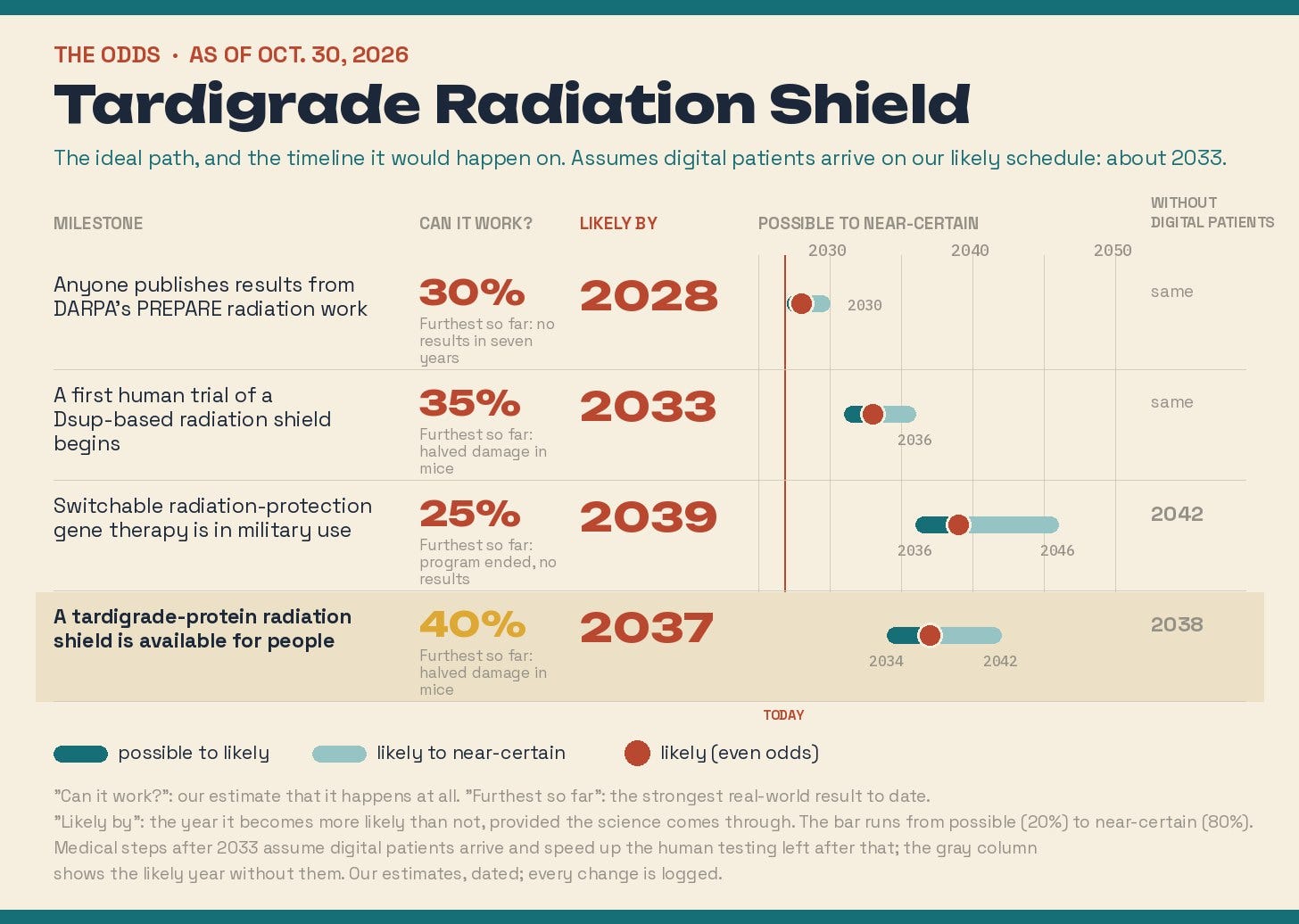
Note, Oct. 30, 2026: We overhauled how we present our odds to make them clearer. Every number we previously published still stands; the chart adds when each step is likely and how much faster it could come with digital patients.
Why these odds
These are our estimates, dated Oct. 25, 2026. They move only on new reporting, and every move is logged.
Any agency or lab publishes results from DARPA's PREPARE radiation work by 2028: 15%. The program page is archived, and seven years have passed since the 2019 award with no public results.
A first human trial of a Dsup-based radiation shield begins by 2032: 10%. Every result is in cells, yeast or mice, the protein harmed mouse neurons, and no developer has announced a trial or timeline.
A tardigrade-protein radiation shield is available for people by 2045: 30%. One reasonable estimate puts this around 2045, with a range of 2038 to 2060; the core idea is unproven in people and its mechanism is still disputed.
Switchable radiation-protection gene therapy is in routine U.S. military use by 2045: 15%. One reasonable estimate puts this around 2045, with a range of 2040 to 2060, but DARPA's program ended without published results and no current military program could be confirmed.