


FREE READ. This one is on the house: the full story, the Odds board and the speculation, open to everyone. Most posts are free through the TL;DR only.
TL;DR
A cancer vaccine made for one person at a time, from the mutations in that person's own tumor, has now passed the biggest test medicine has. In a trial of 1,137 melanoma patients, 82 in 100 who got the custom shot were alive with no cancer return after about two years, against 70 in 100 who got the standard drug alone. That is about 12 more people per 100 still cancer-free. It is not a cure, nobody yet knows whether it helps people live longer, and every dose has to be manufactured individually. But it is the first time an mRNA vaccine against cancer has won a late-stage trial, and regulators are now reviewing it. If it is approved, medicine designed around one patient's tumor stops being an experiment and becomes a product.
Where it stands
The vaccine, from Moderna and Merck, is called intismeran autogene. Each dose is built from the patient's own sequenced tumor, and its mRNA teaches the immune system to recognize up to 34 of that tumor's mutations. It is given alongside Merck's immunotherapy drug Keytruda.
The Phase 3 trial, INTerpath-001, enrolled 1,137 people whose high-risk melanoma had been surgically removed. Two of every three got the vaccine plus Keytruda; the rest got Keytruda plus a placebo. After about two years, 82.2% of vaccinated patients were relapse-free, against 70.0% on Keytruda alone. Put the other way, about 18 in 100 vaccinated patients had their cancer return or died, against 30 in 100 without the vaccine. Over the whole trial, that works out to a 42% lower risk of relapse or death (a hazard ratio of 0.58).
The vaccine also slowed spread. Of vaccinated patients, 88.5% stayed free of cancer in distant organs, against 80.2% on Keytruda alone, a 38% lower risk. Serious side effects were about as common in both groups: 14.2% of vaccinated patients against 13.4%.
The details matter. The two groups' results sat together for the first six months. After that, one analysis shows a 58% cut in risk, so the shot seems to need time to work, and patients who relapsed early gained little. Overall survival data are not yet mature, so whether the vaccine helps people live longer is unknown. The companies say regulators are reviewing the data. No decision date is confirmed. The trial paper has reportedly been accepted by the New England Journal of Medicine.
The open practical question is manufacturing. Each dose is made for one patient, which raises cost and capacity questions that have no public answer yet, The Bio Stories notes.
How we got here
Phase 2b: In the earlier, smaller trial, the vaccine plus Keytruda cut the risk of recurrence or death about in half at five years.
August 19, 2026: Merck and Moderna announced that the Phase 3 trial met its goals, beating Keytruda alone on recurrence-free survival (time without the cancer coming back) and distant metastasis-free survival (time without it spreading to distant organs). It was the first late-stage win for an mRNA cancer vaccine. No numbers were released.
October 21, 2026: Moderna set the full presentation for the ESMO cancer congress in Madrid on Saturday, Oct. 24.
October 22, 2026: The numbers reached reporters early, in what STAT called an embargo break, and the companies then released them. Moderna stock fell 17.6% that day.
October 24, 2026: The scheduled ESMO talk. The figures in this post come from the companies' release and the reporting around it.
What's next
No date given: publication of the INTerpath-001 paper, reportedly accepted by the New England Journal of Medicine.
No date given: a regulatory decision. The companies say review is under way; no date is confirmed.
No date given: mature overall survival data, the number that will show whether the vaccine extends lives.
It would be the first approval of a personalized cancer vaccine of any kind.
The odds (as of Oct. 25, 2026): A personalized mRNA cancer vaccine is approved for melanoma patients by 2028: 70%. Our estimate: the Phase 3 win is in hand and regulators are reviewing; the risk is a request for survival data.
The Odds
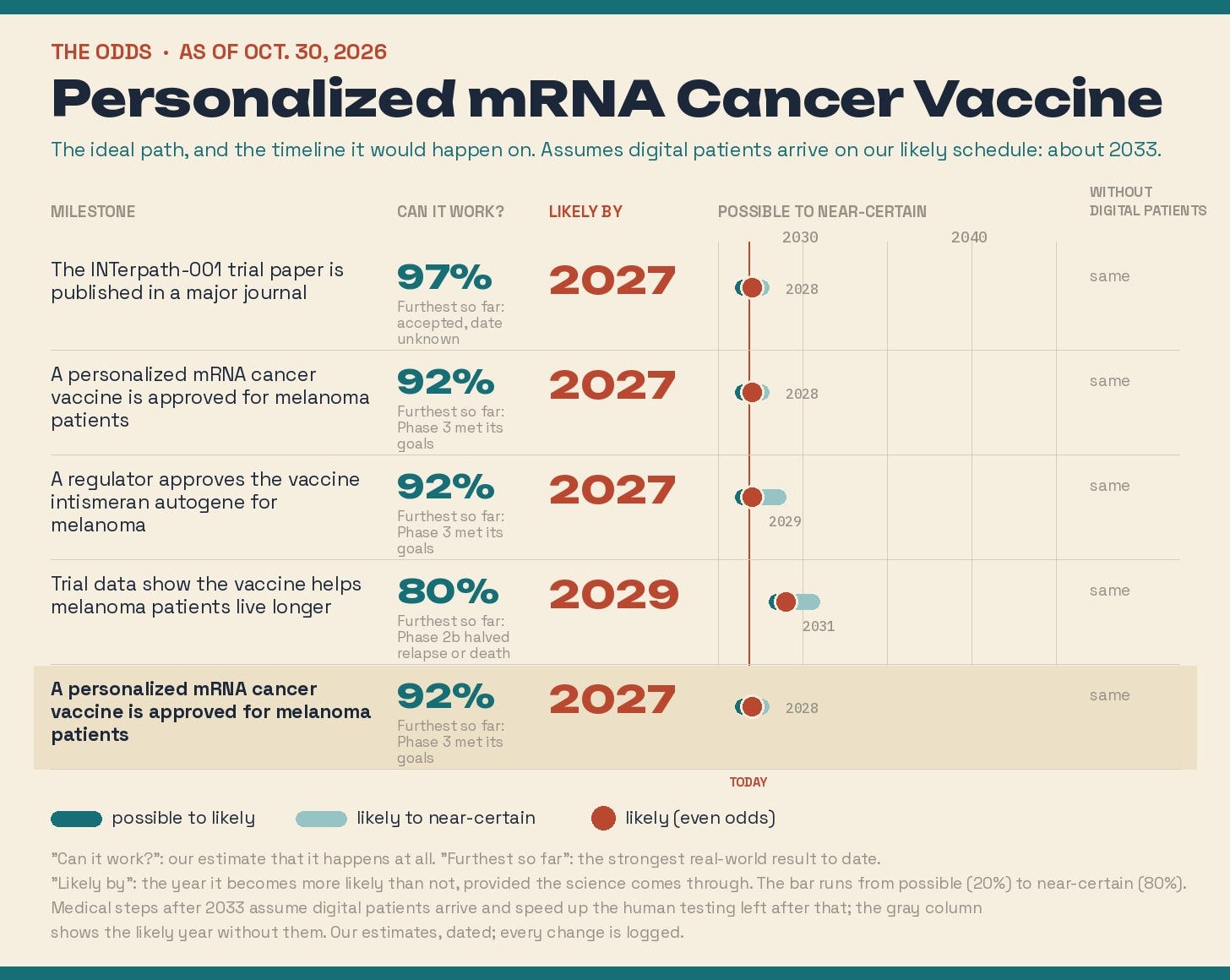
Note, Oct. 30, 2026: We overhauled how we present our odds to make them clearer. Every number we previously published still stands; the chart adds when each step is likely and how much faster it could come with digital patients.
Why these odds
These are our estimates, dated Oct. 25, 2026. They move only on new reporting, and every move is logged.
The INTerpath-001 paper is published in a major journal by 2027: 85%. The paper has reportedly been accepted by the New England Journal of Medicine; only the publication date is unknown.
A regulator approves intismeran autogene for melanoma by 2027: 40%. The companies say regulators are reviewing the data, but no decision date is confirmed and survival data are not mature.
A personalized mRNA cancer vaccine is approved for melanoma patients by 2028: 70%. One reasonable estimate puts this around 2028, with a range of 2027 to 2029; a 1,137-patient Phase 3 met its goals with similar serious side effects, and only review remains.
A personalized mRNA cancer vaccine is approved for melanoma patients by 2029: 80%. The end of the estimated range; the main risks are regulators asking for survival data and the cost of making each dose for one patient.
Trial data show the vaccine helps melanoma patients live longer by 2029: 45%. The earlier Phase 2b roughly halved the risk of recurrence or death at five years, but a relapse benefit does not always become a survival benefit, and patients who relapsed early gained little.